Open Now
1314 FM 646 Rd Suite 24B, Dickinson, TX 77539
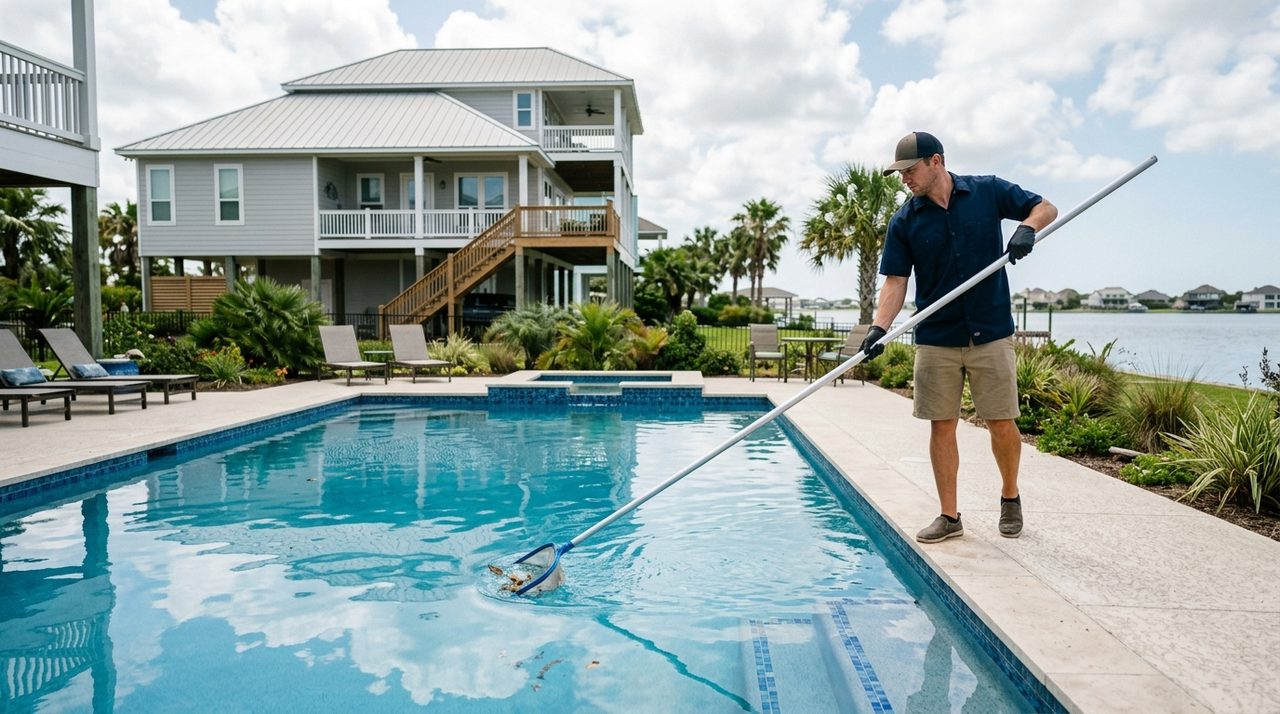
Dickinson pools sit inside FEMA Zone AE along Dickinson Bayou, meaning floodwater, debris, and contaminants enter pool shells during every significant storm — a reality Harvey (2017) and Beryl (2024) proved at scale. Between post-storm chemistry crashes, intense Gulf Coast UV chewing through chlorine, and calcium-laden Galveston County utility water scaling tile lines year-round, pool maintenance here demands a discipline that generic suburban service schedules simply don't address. This page covers the four challenges that actually matter for pool owners in Dickinson and what a knowledgeable local technician should be doing about each one.
Ranked by verified Google rating × review volume × verification tier. How we rank →
Some highly-rated pros serve Dickinson from nearby and may not keep a Dickinson street address. Those are listed under "Also serving Dickinson" with their real city and distance, so you always know where each business is based.
1314 FM 646 Rd Suite 24B, Dickinson, TX 77539
2260 Dickinson Ave ste j, Dickinson, TX 77539
Highly-rated pros based nearby who cover Dickinson. Distance shown from the Dickinson area.
Serving Dickinson Based in League City · 2.5 mi away
Serving Dickinson Based in League City · 3.9 mi away
Serving Dickinson Based in La Marque · 4 mi away
Serving Dickinson Based in League City · 4.2 mi away
Serving Dickinson Based in League City · 4.3 mi away
Serving Dickinson Based in League City · 4.5 mi away
Serving Dickinson Based in League City · 4.6 mi away
Why it matters to you
Because virtually all of Dickinson maps to FEMA Zone AE, floodwater from Dickinson Bayou carries sediment, fertilizer runoff, industrial metals, and biological load directly into pool water during major rain events — as Harvey demonstrated across Bay Colony, Centerfield Lakes, and older bayou-adjacent neighborhoods. A single flood event can spike phosphates and metals while wiping out all free chlorine, leaving water that looks brown or green within 48 hours. Owners who attempt DIY shock treatments without testing first often lock contaminants in place rather than removing them.
What a good pro does
A qualified technician should perform a full water panel — not just chlorine and pH — immediately after any flood event, testing for phosphates, copper, iron, and total dissolved solids before adding any chemicals. Remediation typically involves a drain-and-refill decision tree, multiple rounds of clarifier and shock, and several filter backwashes before the pool is declared safe. Equipment below the flood line, including pump housings and salt cells, must be inspected for silt intrusion before being restarted.
Sources: FEMA National Flood Hazard Layer (NFHL), Harris County Flood Control District
Why it matters to you
Dickinson's Gulf Coast latitude puts summer UV index values regularly at 10–11 from May through September, and the combination of high heat and humidity means an under-stabilized pool can exhaust its free chlorine within hours of a service visit, not days. Pools in newer Dickinson subdivisions like Centerfield Lakes and Bayou Maison typically sit on smaller lots with young or no shade trees, leaving the water surface fully exposed to direct sun all day. Owners sometimes add extra shock between visits without adjusting cyanuric acid, which accelerates the problem rather than solving it.
What a good pro does
A well-run weekly service program for a Dickinson pool should include cyanuric acid (stabilizer) measurement at least monthly, with a target range of 30–50 ppm to protect chlorine from UV breakdown without pushing the concentration so high it suppresses sanitizer effectiveness. Salt chlorinator output rates should be dialed up through peak summer months and verified against actual free chlorine readings rather than assumed constant. Technicians should document chemical readings at each visit so owners can track drift patterns through the season.
Why it matters to you
Water supplied to Dickinson homes — whether through the City of Dickinson utility or one of the area's Municipal Utility Districts drawing from the Gulf Coast Aquifer system — typically arrives with calcium hardness in the 200–400 ppm range. In a hot, evaporative Gulf Coast climate, calcium carbonate precipitates onto waterline tile, plaster surfaces, and heat exchanger fins faster than in cooler markets, and post-Harvey replacements of plumbing and pool equipment in the mid-2010s mean many Dickinson pools are now approaching their first major descaling cycle. Left unmanaged, scale reduces heater efficiency and causes tile grout to crack.
What a good pro does
Technicians should test calcium hardness and total alkalinity at least monthly, adjusting pH carefully to keep calcium carbonate from precipitating — a pH above 7.8 in hard Galveston County water significantly accelerates tile scaling. Periodic application of a sequestering agent helps keep dissolved minerals in suspension. When scale has already built up at the tile line, a professional acid wash or glass-bead descaling should be scheduled before it advances to plaster pitting; equipment heaters in particular should be descaled every two to three years in this water quality environment.
Sources: Texas Commission on Environmental Quality, Municipal permit office (see area profile)
Why it matters to you
Mandatory HOAs governing subdivisions like Bay Colony (managed by Goodwin & Co.) and Centerfield Lakes HOA Inc. require that pool water remain clear to the drain and that pool equipment meet screening and fence specifications recorded in each community's CC&Rs. After a storm like Beryl, when pools across Dickinson turn green within days, HOA architectural and compliance boards can issue violation notices even when the cause is clearly weather-related — owners without service records have no documented defense. Older unrestricted lots near the bayou have no such constraint, but the contrast means Dickinson pool owners need to know which category their property falls into.
What a good pro does
Pool cleaning companies serving HOA communities in Dickinson should provide dated service reports after every visit, noting water clarity, chemical readings, and any equipment issues observed. These records are the homeowner's evidence of due diligence if an HOA compliance notice arrives. For equipment replacements like pump motors or salt cells — which may require a permit through the City of Dickinson Permit Office under Galveston County jurisdiction rather than any Houston-area permitting center — verify whether the HOA also requires pre-approval before the swap is made visible from the street.
Sources: Local HOA / deed restrictions (see area profile), Municipal permit office (see area profile)
Hiring pool cleaning in Dickinson? Dickinson is an incorporated Galveston County city with a wide mix of housing stock—from 1950s–1970s bayou-adjacent homes to 1990s–2010s master-planned subdivisions like Bay Colony and Centerfield Lakes. Situated along Dickinson Bayou in FEMA Zone AE, flood mitigation, foundation repair, and post-storm restoration are central to the home services landscape. Contractors must navigate a patchwork of HOA-governed subdivisions with strict CC&Rs alongside older, unrestricted lots with different structural and regulatory demands.
Building era
1950s–1970s in older bayou-adjacent areas; 1990s–2010s in master-planned subdivisions (Bay Colony, Centerfield Lakes, Bayou Maison, Bayou Park).
Typical style
Production-builder traditional brick veneer in HOA subdivisions (1- and 2-story); ranch-style, split-level, and elevated structures in older bayou-adjacent areas; some manufactured homes and cottages in non-HOA sections.
Foundations
Mixed — concrete slab-on-grade dominates in modern subdivisions; pier-and-beam and elevated pier foundations more common in older bayou-adjacent and lower-lying areas.
Common systems
Modern subdivisions: central A/C with gas or electric furnace, copper or PEX plumbing, 200-amp electrical panels. Older homes: may have original galvanized or cast-iron plumbing, window units or aging central HVAC, and 100- to 150-amp electrical service. Post-Harvey replacements are common across both eras.
What that means for repairs
Post-Harvey flood restoration drove massive renovation activity including full drywall replacement, mold remediation, HVAC replacement, and re-flooring. Ongoing renovation focuses on flood-proofing measures such as foundation elevation, installation of flood vents, and upgraded drainage systems. Older homes near the bayou frequently undergo full gut renovations or elevation projects.
Permit jurisdiction
City of Dickinson Permit Office (incorporated city in Galveston County; does not use Houston Permitting Center).
HOA & deed restrictions
No city-wide HOA. Many subdivisions have mandatory HOAs with recorded CC&Rs, including Bay Colony Community Association (managed by Goodwin & Co.), Centerfield Lakes HOA Inc. (mandatory POA), Bayou Maison HOA (mandatory), and Bayou Park III HOA. Hundreds of homes in Dickinson have no HOA at all, particularly in older areas and individual lots.
Historic districts
No historic district designation confirmed for Dickinson. The city does not have a Houston-style HAHC review process.
Contractor note
Contractors must pull permits through the City of Dickinson and should verify whether the property is in an HOA-governed subdivision with architectural review requirements before beginning exterior work. Flood zone AE designation triggers additional FEMA compliance requirements for substantial improvements or new construction.
FEMA flood zone
FEMA Zone AE (high flood risk) — source: fema_nfhl. Dickinson Bayou runs through the heart of the city, and extensive areas along the bayou and its tributaries are within the AE regulatory floodway and 100-year floodplain.
Hurricane Harvey impact
Dickinson was one of the hardest-hit communities in the entire Houston region during Hurricane Harvey (2017). Dickinson Bayou overflowed massively, inundating large portions of the city. Thousands of homes flooded and the city became a national example of Harvey's devastation. Both HOA subdivisions and older bayou-adjacent neighborhoods experienced severe damage. Many homes required full gut renovations, and some were demolished or elevated post-storm.
Heat & humidity load
High heat and extreme humidity accelerate mold growth in flood-damaged or poorly ventilated structures, a persistent concern given the neighborhood's flood history. Slab foundations in clay soils can shift during summer drought cycles, and aging HVAC systems in older homes are heavily stressed. Coastal proximity adds salt-air corrosion risk to outdoor HVAC condensers, metal roofing, and exterior fixtures.
Working with contractors here
Flood damage restoration and prevention dominate the contractor landscape in Dickinson—mold remediation, drywall replacement, foundation repair, and home elevation projects are consistently in demand due to the AE flood zone designation and Harvey's lasting impact. Plumbing contractors frequently encounter corroded galvanized lines in older bayou-adjacent homes and post-flood pipe replacement needs. HVAC replacement is common across both eras of housing, as many systems were destroyed in Harvey or are aging out in 1990s-era subdivisions. Contractors working in HOA communities like Bay Colony or Centerfield Lakes should obtain architectural approval before exterior modifications. Job scoping in Dickinson must always account for flood history—checking for prior water intrusion, assessing foundation elevation relative to base flood elevation, and confirming whether the property triggers FEMA substantial improvement thresholds.
Local Tip
Always ask for a written estimate before work begins. Texas contractors are required to provide one on jobs over $1,000.
Dickinson is an incorporated Galveston County city with a wide mix of housing stock—from 1950s–1970s bayou-adjacent homes to 1990s–2010s master-planned subdivisions like Bay Colony and Centerfield Lakes. Situated along Dickinson Bayou in FEMA Zone AE, flood mitigation, foundation repair, and post-storm restoration are central to the home services landscape. Contractors must navigate a patchwork of HOA-governed subdivisions with strict CC&Rs alongside older, unrestricted lots with different structural and regulatory demands.
Source: U.S. Census Bureau, ACS 5-Year 2023
Much of Dickinson maps to FEMA Zone AE (high flood risk), so flood-resilient detailing -- elevated equipment, water-tolerant materials, and drainage-first thinking -- is essential here, not optional; risk climbs sharply on blocks nearest Dickinson Bayou, where it varies parcel to parcel.
Source: FEMA National Flood Hazard Layer (NFHL). Flood zones vary by parcel — verify your individual FIRM panel.
Sources: Municipal permit office (see area profile)FEMA National Flood Hazard Layer (NFHL)
Sources: Texas Department of Licensing & RegulationFEMA National Flood Hazard Layer (NFHL)
Sources: Local HOA / deed restrictions (see area profile)
Sources: Texas Department of Licensing & RegulationMunicipal permit office (see area profile)