1700 5th Ave N, Texas City, TX 77590
Best Pool Cleaning in Texas City, TX
Texas City pools face a uniquely compressive set of stresses: salt air off Galveston Bay accelerates corrosion on pump hardware and salt-cell electrodes, while Gulf storm seasons — Harvey 2017 and Beryl 2024 both tracked directly through Galveston County — can dump debris, surge-laced water, and chemical chaos into a pool within hours. Whether your home is a 2010s-era production build in Lago Mar with HOA visibility standards or a mid-century slab house near the historic core, understanding how coastal exposure and Galveston County's water chemistry interact with your pool equipment is what separates a clean pool from a recurring remediation bill.
Verified against Google Business data
Updated 2026
See the 4 Pool Cleaning Serving Texas City 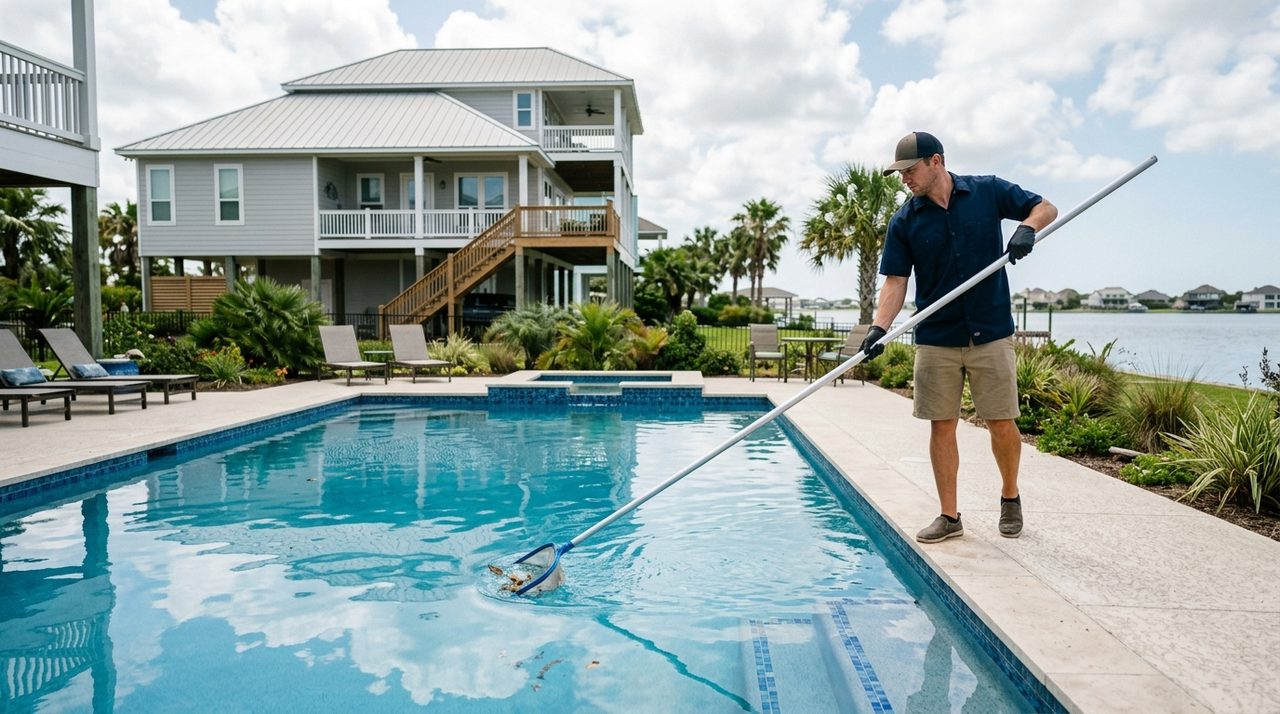
- Median home built
- 1981
- Median home value
- $190,600
- FEMA flood zone
- X (low)
- Routine monthly cleaning (est.)
- $150–$250
- Most common local issue
- Salt-air corrosion on pump hardware and salt-cell electrodes
Ranked by verified Google rating × review volume × verification tier. How we rank →
Some highly-rated pros serve Texas City from nearby and may not keep a Texas City street address. Those are listed under "Also serving Texas City" with their real city and distance, so you always know where each business is based.
Min rating:
4 resultsBased in Texas City
Also serving Texas City
Highly-rated pros based nearby who cover Texas City. Distance shown from the Texas City area.
Open Now
Serving Texas City Based in La Marque · 3.3 mi away
Closed
Serving Texas City Based in La Marque · 3.3 mi away
Closed
Serving Texas City Based in La Marque · 3.8 mi away
Pool Cleaning in Texas City: What You Should Know
Salt-Air Corrosion Eats Equipment Faster Than Inland Pools
Why it matters to you
Texas City sits directly on Galveston Bay, and the prevailing southeast Gulf breeze carries airborne chlorides year-round — a reality that simply does not apply to pools in Katy or The Woodlands. Salt-cell electrodes, pump motor housings, and exposed metal fittings corrode measurably faster here, shortening equipment life and pushing repair costs toward the higher end of the $250–$500 installed range typical for salt-cell replacement in the Houston metro. Older pools near the historic core, many built on mid-20th-century slabs, often have original copper plumbing that reacts with both salt air and pool chemicals to produce telltale blue-green staining on plaster surfaces.
What a good pro does
A qualified pool-cleaning technician servicing Texas City homes should inspect salt-cell electrodes for accelerated calcium bridging and pitting every 60–90 days rather than the standard 90–120-day inland schedule, and should flush and dry-coat exposed metal fittings at each visit. Equipment replacements — pumps, heaters, electrical bonding work — require a permit through the City of Texas City Permits and Inspections Department, not the Houston Permitting Center; contractors unfamiliar with the local jurisdiction should confirm requirements before beginning any swap. Choosing marine-grade or coated equipment components rated for coastal environments adds upfront cost but substantially extends service intervals.
Sources: Municipal permit office (see area profile), Texas Department of Licensing & Regulation
Hurricane and Tropical Surge Recovery in a Galveston County Coastal City
Why it matters to you
Even though most of Texas City maps to FEMA Zone X, Galveston County's direct exposure to Gulf tropical systems means storm-related pool contamination here carries risks that go beyond typical Harris County flash-flood scenarios. Hurricane Beryl made landfall in Galveston County in July 2024, and Harvey's 2017 rainfall totals were catastrophic for the entire region — both events sent organic debris, sediment, and in some coastal blocks, brackish surge water into residential pools, crashing sanitizer levels and spiking phosphates, metals, and turbidity simultaneously. Homeowners in newer communities like Lago Mar and Park Place South, where lot trees are still young and offer minimal screening, found pools exposed to maximum airborne debris.
What a good pro does
Post-storm pool recovery in Texas City should start with a full water panel test — not just a basic chlorine check — to catch metal spikes from storm runoff and brackish contamination that a standard shock treatment alone will not neutralize. Expect a remediation sequence of shock, clarifier, multiple filter backwashes, and possibly a metal sequestrant treatment before water meets safe chemistry standards; budget $250–$600 as a realistic estimate for moderate contamination. Texas law does not require a specific state license for chemical pool maintenance, but technicians applying algaecides classified as pesticides may need a Texas Department of Agriculture pesticide applicator credential — ask any service provider to confirm this status before they treat your pool.
Sources: FEMA National Flood Hazard Layer (NFHL), Texas Department of Licensing & Regulation, Texas Commission on Environmental Quality
HOA Water-Clarity Standards in Lago Mar and Park Place South
Why it matters to you
Texas City's newer master-planned subdivisions are not uniform in their HOA requirements — Lago Mar Owners Association (managed by Principle Management Group) and Park Place South Homeowners Association both maintain active deed restriction enforcement, and water clarity visible to the drain is a common community standard in similar Galveston County HOA developments. With a census-recorded owner-occupancy rate of 53.9% in Texas City, a meaningful share of pool properties may be tenant-occupied or investor-owned, increasing the risk of deferred maintenance that draws an HOA violation notice. Fines and abatement demands can escalate quickly if a pool turns green, particularly during the long Houston-area algae season that runs from roughly March through November.
What a good pro does
Homeowners in Lago Mar and Park Place South should request that their pool-cleaning provider keep dated service logs including water test results and chemical dosing records — this documentation is the fastest way to respond to any HOA inquiry. Weekly service visits during the peak algae season (May through September) are generally necessary to maintain the continuous clarity these communities expect, rather than the bi-weekly schedule that might suffice in a screened or shaded inland pool. HOA status and specific pool standards should be confirmed directly with the relevant management company or via deed records at the Galveston County Clerk's office, since requirements vary lot-by-lot across Texas City.
Sources: Local HOA / deed restrictions (see area profile)
Extreme UV Chlorine Burn-Off on Unshaded Coastal Lots
Why it matters to you
Texas City sits at roughly 29.4°N latitude, and summer UV index values regularly hit 10–11 from May through September — the same brutal solar load that affects the entire Houston metro. In newer subdivisions like Lago Mar and Park Place South, where production-builder lots are compact and landscaping trees planted in the 2010s and 2020s are still maturing, pools have little natural shade coverage, meaning unstabilized chlorine can drop to unsafe levels within hours of a weekly service visit. This is compounded by the coastal wind evaporation effect: higher air exchange rates across open bay-facing lots accelerate both chlorine off-gassing and water loss, concentrating calcium hardness and other minerals from Galveston County's municipal supply.
What a good pro does
Precise cyanuric acid (stabilizer) management is non-negotiable for Texas City pools, with most unshaded residential pools needing stabilizer maintained in the 40–80 ppm range to protect free chlorine through the week between service visits. A good technician will test stabilizer levels monthly, not just spot-check chlorine, and will adjust accordingly rather than defaulting to a fixed chemical dosing schedule designed for shaded inland pools. For newer Lago Mar or Park Place South pools where the chemistry baseline is still being established, an initial full water panel through a certified lab — available through TCEQ-accredited testing — will give a clearer picture of the local supply's hardness and total dissolved solids before dialing in a long-term maintenance protocol.
Sources: Texas Commission on Environmental Quality, Municipal permit office (see area profile)
Pool Cleaning in Texas City: What You Should Know
Hiring pool cleaning in Texas City? Texas City is an incorporated Galveston County city with a wide range of housing stock, from newer master-planned communities like Lago Mar to older neighborhoods near the historic core and refineries. Homeowners here face coastal weather exposure, salt-air corrosion, and varying flood risk depending on elevation and proximity to the bay. Permitting runs through the City of Texas City, not Houston, and HOA requirements vary significantly by subdivision.
- Housing era
- Mixed — older core neighborhoods date to the mid-20th century
- Foundation
- Predominantly slab-on-grade in modern subdivisions
- Flood zone
- FEMA Zone X (low flood risk) per official NFHL data
- Permits
- City of Texas City Permits and Inspections Department (independent municipality, not Houston Permitting Center)
Housing stock & systems
Building era
Mixed — older core neighborhoods date to the mid-20th century; master-planned communities like Lago Mar and Park Place South are primarily 2010s–2020s construction.
Typical style
Modern production-builder suburban homes (brick and stone, one- and two-story) in newer subdivisions; older areas feature more varied Gulf Coast residential styles.
Foundations
Predominantly slab-on-grade in modern subdivisions; some older coastal and bay-adjacent homes may be pier-and-beam or raised construction — confirm via Galveston County Appraisal District records.
Common systems
Newer homes feature modern central HVAC, PEX or CPVC plumbing, and 200-amp electrical panels; older homes may have original ductwork, galvanized or copper plumbing, and smaller electrical services requiring upgrades.
What that means for repairs
Older homes near the historic core often need HVAC modernization, electrical panel upgrades, and corrosion-related exterior repairs due to salt air and industrial proximity. Newer HOA communities focus on cosmetic upgrades and energy efficiency improvements.
Permits & restrictions
Permit jurisdiction
City of Texas City Permits and Inspections Department (independent municipality, not Houston Permitting Center).
HOA & deed restrictions
Mixed — mandatory HOAs govern newer subdivisions including Lago Mar Owners Association (managed by Principle Management Group) and Park Place South Homeowners Association. Older neighborhoods may have only recorded deed restrictions with no active HOA. HOA status must be confirmed lot-by-lot via deed records, Galveston County Clerk, or hoa.texas.gov.
Historic districts
No City of Houston historic district designation confirmed. Texas City is a separate incorporated municipality; any local historic designations would be administered by the City of Texas City.
Contractor note
Contractors must pull permits through the City of Texas City, not Harris County or the City of Houston. HOA-governed subdivisions like Lago Mar and Park Place South require architectural approval before exterior work begins; confirm requirements with the specific HOA management company.
Flood & weather
FEMA flood zone
FEMA Zone X (low flood risk) per official NFHL data. However, Texas City is a low-lying coastal community along Galveston Bay, and localized flooding can occur in areas near Dickinson Bayou, Moses Lake, and the bay shoreline. Flood risk varies significantly by subdivision and elevation.
Hurricane Harvey impact
Specific Harvey 2017 flood depths and damage data for Texas City subdivisions were not confirmed in available research. As a low-lying coastal community in Galveston County, Texas City likely experienced storm surge and rainfall impacts, but street-level or subdivision-specific flood data should be verified through FEMA claims records, the Galveston County Appraisal District, or the Texas General Land Office.
Heat & humidity load
Extreme humidity and salt air from Galveston Bay accelerate exterior corrosion on HVAC condensers, metal roofing components, and fasteners. Older homes without adequate insulation or modern HVAC systems face heavy cooling loads. Mold risk is elevated in poorly ventilated homes, especially those with pier-and-beam foundations near the coast.
Working with contractors here
Texas City's dual housing stock creates two distinct contractor markets. In newer master-planned communities like Lago Mar and Park Place South, work centers on warranty-period punch lists, fence and patio additions within HOA guidelines, and energy-efficiency upgrades. In older neighborhoods, contractors commonly handle HVAC system replacements, electrical panel upgrades from 100-amp to 200-amp service, re-piping from galvanized to PEX, and exterior repairs driven by salt-air corrosion. Coastal proximity means roofing contractors must account for wind uplift ratings and corrosion-resistant fasteners. All work requires City of Texas City permits, and contractors unfamiliar with the local permitting process should budget additional time compared to Houston-area jurisdictions.
Local Tip
Always ask for a written estimate before work begins. Texas contractors are required to provide one on jobs over $1,000.
About Texas City
Texas City is an incorporated Galveston County city with a wide range of housing stock, from newer master-planned communities like Lago Mar to older neighborhoods near the historic core and refineries. Homeowners here face coastal weather exposure, salt-air corrosion, and varying flood risk depending on elevation and proximity to the bay. Permitting runs through the City of Texas City, not Houston, and HOA requirements vary significantly by subdivision.
- Median year built
- 1981
- Median home value
- $190,600
- Owner-occupied
- 53.9%
- Population
- 54,159
- Housing units
- 23,248
- Median income
- $65,447
Source: U.S. Census Bureau, ACS 5-Year 2023
Flood & storm risk
FEMA Zone XLow flood riskMost of Texas City maps to FEMA Zone X (low mapped flood risk), but Houston's flash-flood reality means even low-risk blocks benefit from smart drainage and storm-hardened installs; as a Galveston County coastal community, tropical surge and wind add a layer generic guidance misses.
Source: FEMA National Flood Hazard Layer (NFHL). Flood zones vary by parcel — verify your individual FIRM panel.
Frequently Asked Questions
Do I need a permit from the City of Texas City to replace my pool pump or heater?
Yes — equipment replacements involving electrical connections or gas lines typically require a permit through the City of Texas City Permits and Inspections Department, which is a completely separate jurisdiction from the City of Houston or Harris County permitting offices. Your pool cleaning or repair company must pull the permit locally; contractors accustomed to Houston Permitting Center workflows should budget extra time to get familiar with Texas City's process. Confirm current requirements directly with the City of Texas City before scheduling any equipment swap.
Sources: Municipal permit office (see area profile)
My Texas City home was built in the 1960s near the historic core — do older pools in this area have specific issues pool cleaners should know about?
Pools attached to mid-century homes near Texas City's historic core often have aging plaster, older skimmer bodies, and plumbing that pre-dates modern freeze-guard automation — all of which can be in rougher shape than equipment on newer Lago Mar or Park Place South builds. Salt air accelerates corrosion on any exposed metal fittings or bonding wire, and older pools in this era frequently used copper plumbing that can leach metal ions, causing blue-green staining on plaster. Ask any prospective service tech whether they have experience diagnosing corrosion and staining issues specific to coastal Galveston County pools, not just standard inland chemistry problems.
Texas City maps mostly to FEMA Zone X — does that mean my pool really doesn't need post-storm recovery service after a tropical event?
Zone X means your property has a low mapped flood risk from riverine flooding, but it does not protect against tropical storm surge, extreme rainfall, or wind-blown debris that accompany Gulf systems like Hurricane Beryl (2024), which tracked directly through Galveston County. Even without standing floodwater entering the pool, a major storm can saturate your pool with organic debris, pollen, and wind-driven sediment that crashes chlorine levels and spikes phosphates within 24 to 48 hours. A post-storm recovery service — typically estimated at $250–$600 depending on severity and pool size — is advisable after any named storm makes landfall near Galveston County, regardless of your flood zone designation.
How does the hard water from Galveston County MUD supplies affect how often I need calcium scale service on my Texas City pool?
Many Texas City homes are served by Municipal Utility Districts or local utility providers drawing from the Chicot or Evangeline aquifer, which delivers water with calcium hardness frequently in the 200–400 ppm range — and in a hot, high-evaporation coastal environment, that calcium concentrates quickly on tile lines and plaster. Most Texas City pool owners in these supply areas should expect a professional tile descaling or acid wash every one to three years depending on how tightly their tech manages calcium hardness and total alkalinity between visits. If you're unsure which water supply serves your address, your service provider can test source-water hardness on the first visit and calibrate a treatment plan accordingly.
What should I specifically ask a pool cleaning company before hiring them in Texas City to make sure they understand coastal conditions here?
Ask whether they regularly service pools in Galveston County coastal communities and whether they stock marine-grade or corrosion-resistant replacement parts for pump lids, bonding lugs, and salt-cell fittings — components that degrade significantly faster here than in inland Houston suburbs. Also ask how they handle post-hurricane protocols, specifically whether they test for metals and phosphates after storm events and whether they carry clarifiers and phosphate removers on their service trucks. A tech who only references inland Harris County experience may underestimate how quickly salt air and Gulf storm chemistry can overwhelm a standard maintenance schedule in Texas City.
Does my Lago Mar HOA require proof of professional pool service, and what happens if my pool goes green?
The Lago Mar Owners Association, managed by Principle Management Group, imposes water-clarity standards that typically require pool water to be clear enough to see the drain — a green or turbid pool visible from the street or neighboring property can trigger an HOA violation notice and fine. While the HOA does not necessarily mandate a specific service provider, keeping documentation of regular professional visits (dated service reports showing chemical readings) is the most straightforward way to demonstrate compliance if you receive a notice. If your pool goes green after a storm or during an equipment failure, a remediation service estimated at $250–$600 is usually faster than trying to self-treat, and produces the chemical records the HOA may request as proof of correction.
Sources: Local HOA / deed restrictions (see area profile)