Closed
Serving West University Based in Braeswood · 1 mi away
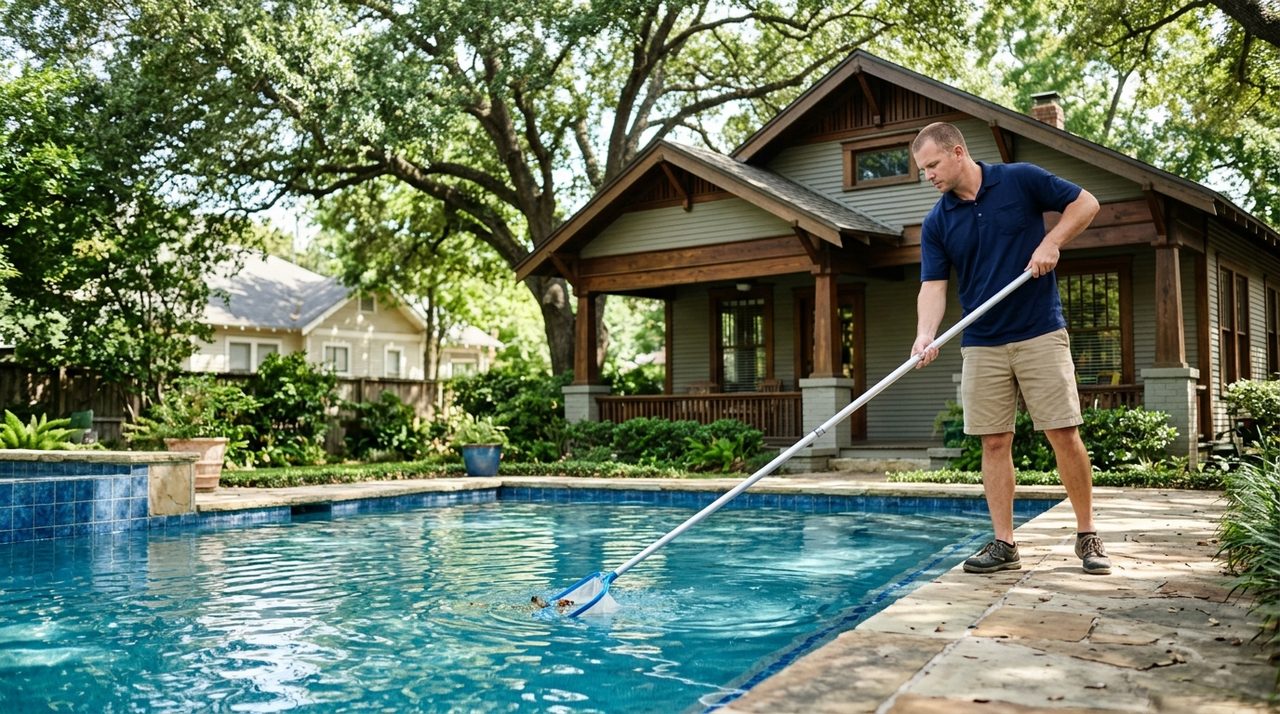
West University Place's pool owners are splitting the difference between two distinct eras: older mid-century homes on mature, heavily canopied lots that dump pollen and leaf litter into pools all year, and newer teardown-rebuild customs from the 1990s–2000s whose exposed PVC pool plumbing was never designed for a hard freeze like Winter Storm Uri. Because West U is an independent municipality, any equipment-level work — pump replacements, heater installs, electrical hookups — requires permits pulled through the City of West University Place's own permit office, not through Houston or Harris County, a detail that catches plenty of contractors flat-footed.
Ranked by verified Google rating × review volume × verification tier. How we rank →
Some highly-rated pros serve West University from nearby and may not keep a West University street address. Those are listed under "Also serving West University" with their real city and distance, so you always know where each business is based.
Highly-rated pros based nearby who cover West University. Distance shown from the West University area.
Serving West University Based in Braeswood · 1 mi away
Serving West University Based in Bellaire · 1.3 mi away
Serving West University Based in Galleria · 1.4 mi away
Serving West University Based in Tanglewood · 2.1 mi away
Serving West University Based in Bellaire · 2.3 mi away
Serving West University Based in River Oaks · 3.4 mi away
Serving West University Based in River Oaks · 3.6 mi away
Serving West University Based in Meyerland · 3.8 mi away
Serving West University Based in Tanglewood · 4.1 mi away
Serving West University Based in Lazybrook / Timbergrove · 4.3 mi away
Why it matters to you
West University's signature tree-lined streets — many with live oaks and elms planted decades ago on the original 1930s–1950s plats — shed pollen, leaves, and organic debris directly into pools on smaller lots where canopy overhangs the water surface. Phosphate accumulation from decomposing organic matter feeds algae blooms continuously, not just after storms, keeping sanitizer demand elevated even during cooler months when the pool isn't being heavily used.
What a good pro does
A good service tech here should test phosphate levels at every visit — not just on complaint calls — and apply a phosphate remover or clarifier before levels spike past 500 ppb. Weekly brushing of waterline tile and plaster is non-negotiable given the organic load. Because West U lots are frequently being replanted after teardown-rebuilds, ask your tech to flag any new tree installations near the pool shell that could worsen debris loading over time.
Why it matters to you
The bulk of the pool stock on West University's rebuilt lots dates to the 1990s and 2000s, when teardown-rebuild activity reshaped the neighborhood. That era's equipment pads feature largely exposed, uninsulated PVC plumbing that was not equipped with automated freeze guards — exactly the configuration that shattered pump housings and cracked return lines across the metro during Winter Storm Uri in February 2021. West U's inner-loop location offers only marginal temperature advantage over northern suburbs, and a single overnight hard freeze is enough to cause expensive damage.
What a good pro does
A qualified service tech should audit freeze-guard installation status on every piece of equipment — pump, heater, salt cell, and automation controller — and verify that any automated freeze protection is set to activate at or above 35°F before winter. Equipment-level repairs and heater replacements require permits pulled through the City of West University Place's own permit office; confirm that your contractor is pulling those locally, not assuming Houston Permitting Center jurisdiction applies.
Sources: Municipal permit office (see area profile), Texas Department of Licensing & Regulation
Why it matters to you
West University sits in FEMA Zone X500 — moderate flood risk, outside the 100-year floodplain but inside the 500-year. Events like Hurricane Beryl in July 2024 and the May 2024 derecho brought storm surge of debris, sediment, and overtaxed drainage into pools even on lots that did not flood indoors. A single major rain event can crash free chlorine to zero, spike turbidity, and introduce metals from runoff across the neighborhood's mix of mature and newly landscaped lots.
What a good pro does
After any named storm or derecho, schedule an immediate follow-up service call rather than waiting for the next scheduled weekly visit. Expect the tech to perform a full chemistry panel — including metals and phosphates, not just chlorine and pH — before shock-dosing. Multiple filter backwashes and a clarifier application are typically needed before the water returns to safe, visible-to-the-drain clarity. Cost estimates for a single green-pool remediation after storm events typically run $250–$600 depending on pool size and chemical load required.
Sources: FEMA National Flood Hazard Layer (NFHL), Harris County Flood Control District
Why it matters to you
Newer teardown-rebuild custom homes in West U frequently feature pools on lots where large shade trees were removed during construction and young replacement plantings haven't grown to provide coverage. Houston's summer UV index regularly reaches 10–11 from May through September at roughly 29.8°N latitude, destroying unstabilized free chlorine within hours of a service visit — meaning a pool dosed on a Monday morning can test near zero by Tuesday afternoon in full sun.
What a good pro does
Cyanuric acid (stabilizer) management is more important in West U's open-sky rebuilt pools than any other single chemistry variable in summer. A good tech should keep stabilizer in the 30–50 ppm range and retest mid-week if the pool is in full sun or sees heavy bather load. Salt chlorinator cell output should be calibrated upward in peak summer months; salt cell replacement (typically $250–$500 installed, est.) is a permitted equipment job that requires the City of West University Place's permit office, not Houston's.
Sources: Municipal permit office (see area profile), Texas Department of Licensing & Regulation
Hiring pool cleaning in West University? West University Place is an independent municipality within the Inner Loop featuring a mix of original 1930s–1950s bungalows and larger custom homes built from the 1980s onward as teardown-rebuild cycles reshaped the neighborhood. Homeowners here navigate the city's own permitting process—separate from Houston's—and must account for aging systems in older homes alongside modern construction standards in newer builds. The tree-lined streets and high property values drive demand for premium finishes and careful code compliance.
Building era
Mixed: original homes from 1930s–1950s with significant infill and teardown-rebuild construction from the 1980s–2000s and continuing today.
Typical style
Traditional brick, Georgian/Colonial-influenced, neo-traditional custom homes (2-story), with some remaining early-20th-century bungalows and cottages.
Foundations
Not confirmed from available sources - likely mixed pier-and-beam on older pre-1950s homes and slab-on-grade on newer construction. Verify on a per-property basis.
Common systems
Older homes (1930s–1950s) may have original galvanized or cast-iron plumbing, outdated electrical panels, and window AC or early central HVAC. Newer construction (1980s–present) typically features copper or PEX plumbing, modern electrical, and high-efficiency central HVAC systems.
What that means for repairs
Teardown-and-rebuild activity has been the dominant renovation pattern for decades, replacing smaller original cottages with larger custom homes. Remaining older homes frequently undergo full-gut renovations including electrical rewiring, plumbing replacement, foundation repair, and HVAC modernization to meet current standards and market expectations.
Permit jurisdiction
City of West University Place (independent municipality - own permit office, not City of Houston Permitting Center and not Harris County).
HOA & deed restrictions
No mandatory city-wide master HOA. West U functions as an independent municipality with its own zoning and code enforcement. Individual condo and townhome associations exist (e.g., The Oaks at West University Condominium Association), but most single-family homes have no HOA. Deed restrictions may exist on individual plats—check Harris County Clerk records for specific lots.
Historic districts
No City of Houston historic district designation applies. West University Place is an independent municipality outside Houston city limits, so HAHC Certificates of Appropriateness are not required. West U may have its own local design or zoning controls—check with the City of West University Place directly.
Contractor note
Contractors must pull permits through the City of West University Place, not through Houston or Harris County. West U's own inspectors enforce local codes, and the city's zoning and building requirements may differ from Houston's, so contractors unfamiliar with the jurisdiction should review local ordinances before bidding.
FEMA flood zone
FEMA Zone X500 (moderate flood risk) per official NFHL data. West University Place sits between Brays Bayou to the south and Rice University to the east, with drainage flowing into Harris County Flood Control District channels.
Hurricane Harvey impact
Specific Harvey 2017 flood impact data for West University Place streets was not available in the research provided. The moderate flood risk zone designation and proximity to Brays Bayou suggest potential vulnerability, but confirmed street-level flooding details and repetitive-loss areas should be verified through HCFCD inundation maps and City of West University Place floodplain reports.
Heat & humidity load
Houston's extreme summer heat and humidity stress HVAC systems across all housing eras. Older pier-and-beam homes may experience moisture-related subfloor issues, while the mature tree canopy—a signature feature of West U—creates ongoing gutter maintenance demands and potential root intrusion into aging sewer lines.
Working with contractors here
Contractors in West University most commonly handle full-home renovations and teardown-rebuilds, driven by buyers acquiring older cottages on valuable lots and replacing them with larger custom homes. For surviving 1930s–1950s homes, foundation repair, whole-house repiping (replacing galvanized with copper or PEX), electrical panel upgrades, and HVAC replacement are frequent scopes. Newer 1990s–2000s homes generate demand for roof replacements, exterior paint, and kitchen/bath remodels as they reach their first major maintenance cycles. Job scoping must account for West University Place's independent permitting process, which can differ from Houston's in turnaround times and inspection requirements. The high-end market expectations in West U mean contractors should budget for premium materials and meticulous finish work.
Local Tip
Always ask for a written estimate before work begins. Texas contractors are required to provide one on jobs over $1,000.
West University Place is an independent municipality within the Inner Loop featuring a mix of original 1930s–1950s bungalows and larger custom homes built from the 1980s onward as teardown-rebuild cycles reshaped the neighborhood. Homeowners here navigate the city's own permitting process—separate from Houston's—and must account for aging systems in older homes alongside modern construction standards in newer builds. The tree-lined streets and high property values drive demand for premium finishes and careful code compliance.
Source: U.S. Census Bureau, ACS 5-Year 2023
West University carries FEMA Zone X500 (moderate flood risk): outside the 100-year floodplain but inside the 500-year, so heavy-rain events still reach homes and flood-aware work pays off.
Source: FEMA National Flood Hazard Layer (NFHL). Flood zones vary by parcel — verify your individual FIRM panel.
Sources: Municipal permit office (see area profile)
Sources: Local HOA / deed restrictions (see area profile)