1006 Hamilton St, Waller, TX 77484
Best Water & Flood Restoration in Waller, TX
Waller, TX sits in Waller County northwest of Houston where FEMA Zone X designation offers some reassurance, but the same expansive Houston Black clay soils that plague the broader metro mean even a plumbing failure or a stalled thunderstorm can trap water against slab edges for days. The housing stock here spans 1980s ranch-style rural properties to brand-new Beacon Hill subdivision homes, and each era carries distinct restoration vulnerabilities — from aging galvanized supply lines in older homes to poorly dried wall cavities from Winter Storm Uri. Permit jurisdiction in Waller is not a given: your parcel may fall under the City of Waller's permit office or Waller County engineering, and getting that wrong delays insurance close-out.
Verified against Google Business data
Updated 2026
See the 2 Water & Flood Restoration Serving Waller 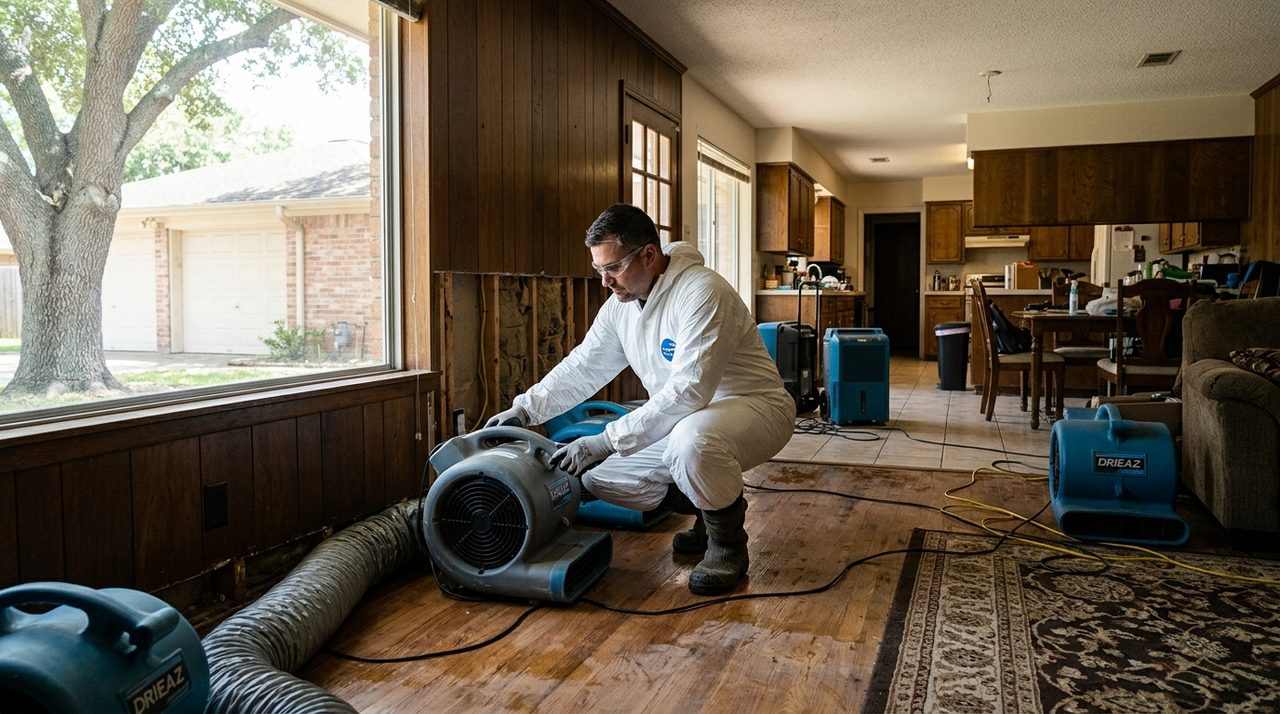
- Median home built
- 1987
- Median home value
- $115,100
- FEMA flood zone
- X (low)
- Typical mitigation cost (est.)
- $3,500–$15,000
- Most common local issue
- Pipe-burst hidden moisture in older rural homes with uninsulated attic plumbing
Ranked by verified Google rating × review volume × verification tier. How we rank →
Min rating:
2 results Open Now
19286 Kickapoo Rd, Waller, TX 77484
Water & Flood Restoration in Waller: What You Should Know
Uri-Era Pipe Bursts Still Hiding Behind Drywall in Older Rural Properties
Why it matters to you
Waller's older rural homes — many built in the 1970s and 1980s with supply lines running through unconditioned attic space — were among the hardest hit by Winter Storm Uri in February 2021. With a census median year built of 1987, a significant share of the housing stock here pre-dates modern PEX plumbing and attic insulation standards. Many owners patched visible damage at the time but never fully dried wall cavities, leaving residual moisture that quietly feeds Cladosporium or Aspergillus growth behind undisturbed drywall — a problem that surfaces only when a contractor opens a wall for an unrelated repair.
What a good pro does
A qualified restoration contractor will use thermal imaging cameras and calibrated moisture meters to scan interior walls before any new work begins, flagging anomalies consistent with years-old wetting events. Any confirmed microbial growth requires remediation by a TDLR-licensed Mold Remediation Contractor (MRC) under Texas Occupations Code Chapter 1958 before new finishes go in. Plumbing line repairs exposed during demo must be performed by a TSBPE-licensed plumber.
Sources: Texas Department of Licensing & Regulation, Texas State Board of Plumbing Examiners, IICRC (water/mold restoration standards)
Clay Soil Keeps Slab Edges Wet Long After the Rain Stops
Why it matters to you
Even in FEMA Zone X, a heavy Gulf-moisture event or a broken irrigation line can leave Waller County's expansive clay soil saturated against a slab perimeter for two to three weeks. On both newer Beacon Hill subdivision slabs and older ranch-style slab homes in unincorporated Waller County, that sustained soil contact wicks moisture into bottom plates and lower wall cavities well after visible puddles are gone. Homeowners who start reconstruction before the slab edge is truly dry risk trapping moisture under new flooring — a condition that almost guarantees mold and flooring failure within one cooling season.
What a good pro does
Proper drying protocol for Waller's clay-soil environment calls for psychrometric monitoring (temperature, relative humidity, and dew point tracked daily) and commercial dehumidification deployed until moisture readings in the bottom plate match the regional EMC standard, not just when the floor feels dry underfoot. IICRC S500 drying documentation should be provided to your insurer as proof that the drying timeline matched actual conditions rather than an arbitrary number of days.
Sources: IICRC (water/mold restoration standards), FEMA National Flood Hazard Layer (NFHL)
Wind-Driven Rain Getting Into Newer Subdivision Homes Through Soffit Vents and Window Flanges
Why it matters to you
The May 2024 derecho and seasonal Gulf thunderstorms track directly across NW Houston, and Waller's newer 2010s–2020s subdivision homes — including those in Beacon Hill — feature complex rooflines, brick veneer, and vinyl window installations that can allow wind-driven rain to enter wall cavities without any interior flooding. This top-down moisture pathway is frequently missed: water enters through a soffit vent or an improperly flashed window flange, runs down wall sheathing, and pools at the bottom plate days before a homeowner notices a stain or smell.
What a good pro does
Restoration professionals use forward-looking infrared (FLIR) thermal cameras to locate the moisture plume inside the wall assembly, tracing it from entry point to terminus — a very different approach than the bottom-up extraction strategy used for flood work. Exterior re-cladding or window reflashing triggered by the damage investigation may require a permit from either the City of Waller permit office or Waller County Engineering depending on your parcel location; confirm jurisdiction before any exterior work begins to avoid a stop-work order.
Sources: IICRC (water/mold restoration standards), Municipal permit office (see area profile)
Permit Jurisdiction Confusion Delaying Insurance Certificate of Completion
Why it matters to you
Waller sits in a split regulatory environment: parcels inside the city limits fall under the City of Waller's permit office, while the substantial unincorporated areas of Waller County are governed by Waller County Engineering — two entirely separate offices with different forms, fees, and inspection schedules. With a low owner-occupancy rate of just 27.6% (ACS 2023), many Waller properties are rentals or investment homes whose owners are not local and may not know which jurisdiction applies. Submitting a demolition or trade permit to the wrong office can freeze a project for weeks, delaying the Certificate of Completion that most insurers require before releasing reconstruction funds.
What a good pro does
Before pulling any permit, confirm jurisdiction by looking up the parcel address through the Waller County Appraisal District or calling both the City of Waller and Waller County Engineering directly to verify which office has authority. The restoration contractor typically pulls the demolition permit, while the TSBPE-licensed plumber and TDLR-licensed electrician each pull their own trade permits under the same jurisdiction. Document every permit number and inspection sign-off and attach them to the insurance claim file.
Sources: Municipal permit office (see area profile), Texas State Board of Plumbing Examiners, Texas Department of Licensing & Regulation
Water & Flood Restoration in Waller: What You Should Know
Hiring water & flood restoration in Waller? Waller sits in unincorporated and incorporated areas of Waller County northwest of Houston, featuring a mix of older rural properties and newer subdivision development. Homeowners here benefit from relatively low flood risk but should verify deed restrictions and permit jurisdiction on a parcel-by-parcel basis, as the regulatory landscape varies significantly across the area.
- Housing era
- Not confirmed - housing stock spans multiple decades, with newer construction (2010s–2020s) appearing in…
- Foundation
- Not confirmed - slab-on-grade is typical for newer construction in the region
- Flood zone
- FEMA Zone X (low flood risk) - source
- Permits
- Not confirmed with certainty
Housing stock & systems
Building era
Not confirmed - housing stock spans multiple decades, with newer construction (2010s–2020s) appearing in subdivisions like Beacon Hill alongside older rural properties.
Typical style
Not confirmed - likely a mix of ranch-style homes on larger lots and newer suburban construction in master-planned communities.
Foundations
Not confirmed - slab-on-grade is typical for newer construction in the region; older properties may include pier-and-beam.
Common systems
Not confirmed - newer homes likely feature modern central HVAC and PEX plumbing; older rural properties may have aging systems requiring updates.
What that means for repairs
Not confirmed - older rural properties in the area likely drive demand for system upgrades (HVAC, plumbing, electrical), while newer subdivision homes may require cosmetic updates and outdoor living additions.
Permits & restrictions
Permit jurisdiction
Not confirmed with certainty. Properties within the City of Waller would use the City of Waller permit office; properties in unincorporated Waller County would fall under Waller County engineering. Verify jurisdiction by parcel address.
HOA & deed restrictions
Not confirmed - some subdivisions in the Waller area may have mandatory HOAs or POAs, but no specific HOA was identified for the broader Waller community. Check deed and Waller County real property records or the TREC HOA Management Certificate database.
Historic districts
No City of Houston historic district designation confirmed. Waller is outside the City of Houston and HAHC jurisdiction.
Contractor note
Contractors should verify whether each job site falls within the City of Waller or unincorporated Waller County, as permit requirements and inspection processes differ. Deed restrictions, if any, should be confirmed through Waller County Clerk records before beginning exterior modifications.
Flood & weather
FEMA flood zone
FEMA Zone X (low flood risk) - source: fema_nfhl. Specific bayou or creek proximity for individual parcels should be verified, but the overall area carries minimal federally designated flood risk.
Hurricane Harvey impact
Not confirmed - no street-level flood data or Harvey inundation records were found for the specific Waller neighborhood area. Check Harris County and Waller County flood claim records for parcel-specific Harvey impact.
Heat & humidity load
Houston-area summers bring sustained high heat and humidity. Homes in Waller, particularly older rural structures, may experience increased HVAC strain, moisture intrusion issues, and foundation movement during prolonged dry spells. Newer subdivision homes benefit from modern insulation and drainage but still require regular HVAC maintenance and attic ventilation checks.
Working with contractors here
Contractors working in Waller encounter a split market: newer subdivision homes needing warranty-era repairs, outdoor living additions, and fence installations, alongside older rural properties requiring full system overhauls including HVAC replacement, re-plumbing, and electrical panel upgrades. The low flood risk reduces demand for flood mitigation work, but foundation monitoring remains important given the expansive clay soils common across Waller County. Job scoping should account for potentially longer material delivery times given the area's distance from central Houston supply hubs, and contractors must confirm the applicable permit jurisdiction before starting work.
Local Tip
Always ask for a written estimate before work begins. Texas contractors are required to provide one on jobs over $1,000.
About Waller
Waller sits in unincorporated and incorporated areas of Waller County northwest of Houston, featuring a mix of older rural properties and newer subdivision development. Homeowners here benefit from relatively low flood risk but should verify deed restrictions and permit jurisdiction on a parcel-by-parcel basis, as the regulatory landscape varies significantly across the area.
- Median year built
- 1987
- Median home value
- $115,100
- Owner-occupied
- 27.6%
- Population
- 3,062
- Housing units
- 1,300
- Median income
- $37,163
Source: U.S. Census Bureau, ACS 5-Year 2023
Flood & storm risk
FEMA Zone XLow flood riskMost of Waller maps to FEMA Zone X (low mapped flood risk), but Houston's flash-flood reality means even low-risk blocks benefit from smart drainage and storm-hardened installs.
Source: FEMA National Flood Hazard Layer (NFHL). Flood zones vary by parcel — verify your individual FIRM panel.
Houston Storm Readiness in Waller
Hurricane & flooding
Water-restoration companies serving Waller, TX can install or recommend backflow prevention add-ons on floor drains and advise on contents-elevation strategies that limit category-2 water contact during a tropical event. The May 2024 derecho reminded Houston homeowners that extreme rain is not exclusive to named hurricanes, making year-round readiness essential. As a Waller County community, Waller may follow county rather than City of Houston storm rebuild rules.
Severe storms & hail
Straight-line winds exceeding 80 mph, as recorded during the 2024 derecho, broke seals on sliding glass doors and drove water into flooring assemblies throughout Waller, TX neighborhoods with no prior flood history. Contact a licensed Texas restoration firm — TDLR regulates their mold-assessment and remediation work — to inspect and dry any affected areas before summer humidity accelerates microbial growth. As a Waller County community, Waller may follow county rather than City of Houston storm rebuild rules.
Ice storms & freezes
A hard freeze in Waller, TX can split a single supply line and deposit 50 or more gallons of water into a ceiling assembly before a homeowner locates the shutoff, and that volume requires more than fans and open windows to dry safely. Texas law under TDLR requires mold assessors and remediators to hold specific licenses, so verify your restoration contractor's credentials before you need them under emergency conditions. Confirm the current FEMA panel for your Waller parcel — the area maps to Zone X, but adjacent lots can differ.
Sources: FEMA National Flood Hazard Layer (NFHL), Ready.gov -- Hurricanes, CenterPoint Energy -- Storm Center, City of Houston -- Emergency Preparedness, Ready.gov -- Winter Weather, Harris County Flood Control District
Free Waller Tools & Calculators
Houston-specific estimators to plan your project before you call a pro. All results are planning estimates — a licensed local pro confirms the details on site.
Houston Freeze Prep & Pipe Insulation Checklist
Open full tool & FAQ →Your freeze checklist — 4 tasks
- 1
Disconnect & drain every outdoor hose bib
Remove hoses, drain the spigots, and cover each with an insulated faucet sock. Un-drained hose bibs are the #1 burst point in a Houston freeze.
- 2
Insulate exposed pipes in the attic & garage
Wrap any pipe in an unconditioned space (attic runs, garage walls) with foam sleeves. Houston homes rarely insulate these because they only matter a few nights a year — which is exactly why they burst.
- 3
Open cabinet doors & keep a pencil-width drip
On hard-freeze nights, open kitchen/bath cabinets so warm air reaches the pipes and let faucets on exterior walls drip to relieve pressure.
- 4
Protect the attic/garage water heater & its lines
An attic or garage tank sits in unconditioned space. Insulate the cold-inlet and hot-outlet lines and confirm the emergency drain pan is clear so a leak doesn't reach the ceiling.
This is a planning estimate only — actual requirements depend on an on-site assessment by a licensed Houston pro. If a pipe has already burst, shut off your main water supply and call a licensed Houston plumber immediately — freeze bursts flood fast.
Frequently Asked Questions
My Waller home is in FEMA Zone X — do I still need a full restoration scope if a plumbing burst floods two rooms?
Zone X means you're outside the mapped high-risk floodplain, but that designation has no bearing on how a plumbing loss is scoped — IICRC S500 drying standards apply regardless of flood zone, and Waller County's expansive clay soils mean moisture against your slab edge can linger for weeks even after visible water is gone. A restoration contractor still needs to run moisture meters and thermal imaging to confirm drying is complete before closing up walls, especially in older 1980s ranch-style homes where fiberglass batt insulation holds water longer than modern alternatives. Skipping a thorough scope because your flood risk is 'low' is one of the most common ways Waller homeowners end up with mold behind drywall months later.
Sources: IICRC (water/mold restoration standards)FEMA National Flood Hazard Layer (NFHL)
Who do I call to pull a demolition permit for flood demo in Waller — the City of Waller or Waller County?
That depends entirely on which side of the city limits your parcel falls on, and in Waller the line is not always obvious — properties on the same road can fall under different jurisdictions. If your address is within the incorporated City of Waller, contact the City of Waller permit office directly; if you're in unincorporated Waller County, permits route through Waller County engineering. Confirm your jurisdiction by looking up your parcel in the Waller County Appraisal District records before your restoration contractor submits anything, because a mis-routed permit application can delay the Certificate of Completion your insurer needs to close the claim.
Sources: Municipal permit office (see area profile)
How long does structural drying typically take for a slab-on-grade home in Waller after a pipe burst or storm intrusion?
For a newer slab home in Waller with moderate water intrusion, structural drying typically runs 3–5 days under ideal equipment conditions, but clay-heavy soils in Waller County can push that to 7–10 days for perimeter walls and bottom plates where soil holds moisture against the slab edge. These are estimates — actual timelines depend on affected square footage, how long water sat before extraction began, and ambient humidity during drying. Your contractor should be reading moisture levels daily with calibrated meters and should not demobilize equipment until readings return to regional equilibrium, generally 12–16% for wood framing in this climate.
Does my Waller subdivision's POA or deed restriction affect how fast a restoration crew can set up dumpsters or remove water-damaged exterior materials?
Some newer Waller subdivisions — including portions of Beacon Hill — do have deed restrictions or POA rules that technically govern exterior modifications and equipment placement, even for emergency work. Check your deed and the Waller County Clerk's records for any deed restriction language before assuming you have a free hand; a restoration contractor who skips that step can trigger a neighbor complaint that slows exterior demo at exactly the wrong moment since IICRC S500 calls for drying to begin within 24–48 hours of a loss. If your subdivision has a POA, notify them in writing the same day work starts and document the emergency nature of the scope.
Sources: Local HOA / deed restrictions (see area profile)IICRC (water/mold restoration standards)
Are Waller restoration contractors required to hold a mold license if they find mold during a water damage job on my older rural property?
Yes — any contractor performing mold remediation in Texas must hold a TDLR-issued Mold Remediation Contractor (MRC) license under Texas Occupations Code Chapter 1958, regardless of whether the job started as a water loss or a mold-only scope. This matters in Waller because older rural properties built in the 1980s frequently have undisclosed moisture history, and a technician who pulls back drywall and finds active mold cannot legally remediate it without that license. Always ask for the MRC license number before remediation work begins and verify it is current on the TDLR license lookup.
My insurer says my Waller home's water damage is Category 2 gray water, but the water came from a backed-up drain during a heavy storm — is that the right classification?
Possibly not. If stormwater surcharge caused a drain backup, the water may qualify as Category 3 under IICRC S500 because municipal or septic drain systems typically carry sewage contamination during overflow events, and Waller County's older rural properties sometimes rely on private septic systems that can backflow during heavy rain. Category 3 classification triggers a more aggressive demo scope — full removal of porous materials to at least 12 inches above the flood line — which is a larger insurance payout than Category 2 allows. Your restoration contractor should document the water source, collect surface samples if needed, and submit that evidence to your adjuster in writing to defend the correct classification.
Sources: IICRC (water/mold restoration standards)Texas Commission on Environmental Quality