Open Now
38359 Bonnie Lake Dr S N, Hempstead, TX 77445
Hempstead's housing stock runs from pre-World War II pier-and-beam frames in the original city core to slab-on-grade tract builds sprouting along the US-290 corridor in the 2000s and 2020s, meaning a water loss here can look wildly different depending on which block you're on. Even though most of Hempstead maps to FEMA Zone X—lower flood risk than Houston's bayou corridors—Gulf-fueled stalled fronts regularly dump several inches of rain in hours on flat Waller County terrain, turning roadside ditches into fast-moving sheet flow that undercuts slabs and pools against older foundations. Understanding whether your parcel falls inside City of Hempstead limits or in unincorporated Waller County is the first call any restoration contractor must make, because those two jurisdictions issue permits through entirely separate offices with different forms and inspection timelines.
Ranked by verified Google rating × review volume × verification tier. How we rank →
38359 Bonnie Lake Dr S N, Hempstead, TX 77445
Why it matters to you
The original Hempstead townsite—blocks near downtown and along older residential streets—contains a significant share of pre-WWII and mid-century frame homes built on pier-and-beam foundations. When flash flooding or a plumbing failure sends water under these houses, the crawl space traps moisture against wooden sill plates, floor joists, and subflooring for weeks, long after standing water is pumped out. Waller County's clay-heavy soils retain ground moisture against the foundation perimeter even in dry weather, so prolonged saturation after a heavy rain event dramatically extends structural drying timelines compared to a newer slab home.
What a good pro does
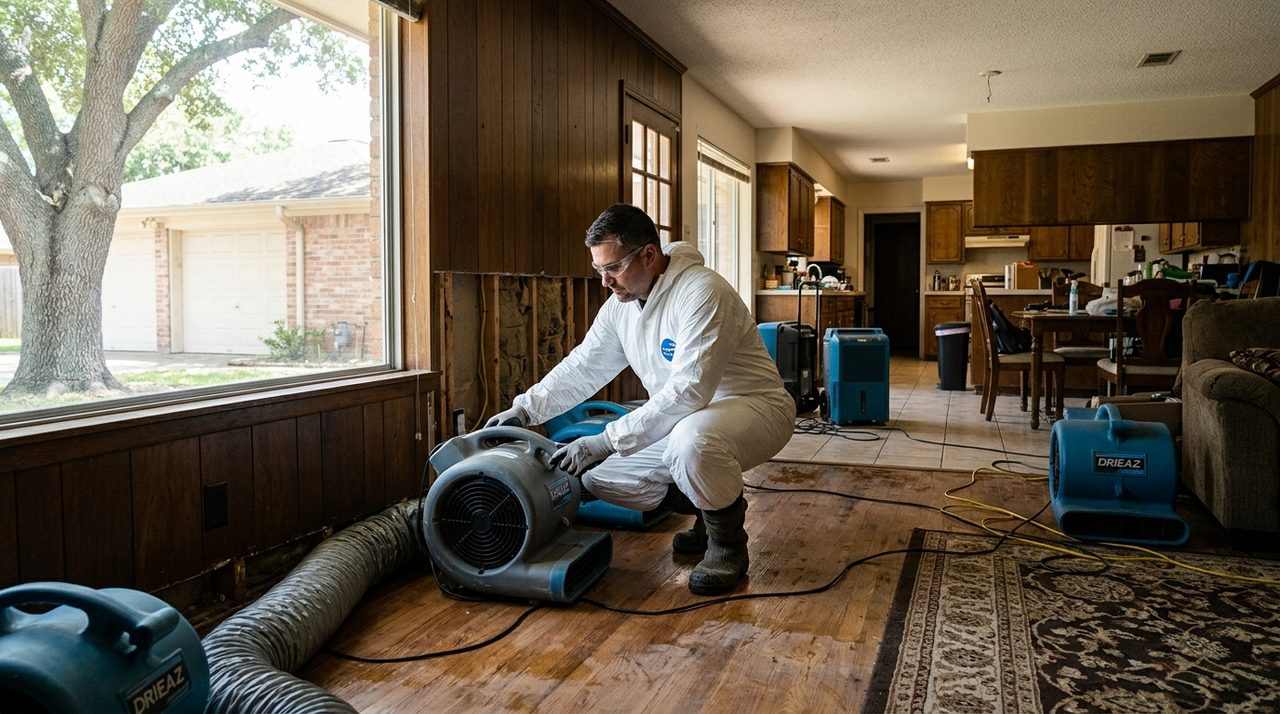
A qualified restoration contractor will use calibrated moisture meters and thermal imaging to map the full moisture column from the crawl space up through the subfloor and wall base before setting any drying equipment—IICRC S500 standards govern this documentation process. Drying equipment must be staged both below and above the floor deck, and drying logs must be maintained throughout. For mold that develops in hard-to-reach crawl spaces, the contractor must hold a TDLR-issued Mold Remediation Contractor (MRC) license to legally perform remediation in Texas.
Sources: IICRC (water/mold restoration standards), Texas Department of Licensing & Regulation
Why it matters to you
Newer brick-veneer-and-siding tract subdivisions built along the US-290 growth corridor since the early 2000s sit on conventional or post-tension slabs—standard for the region—but Waller County's clay-content soils behave much like the expansive Houston Black clay found throughout the greater metro. When heavy rainfall overtops drainage swales or a supply line fails inside the wall, water infiltrates the slab edge and wicks into bottom plates and drywall for an extended period after visible puddles disappear. Homeowners in these subdivisions often pull up saturated flooring, see a dry slab surface, and assume the problem is resolved—when in fact the moisture front has already climbed 12 to 18 inches up interior wall framing.
What a good pro does
Restoration pros must probe bottom plates and wall cavities at multiple heights with penetrating moisture meters and should not release drying equipment until readings return to regional equilibrium moisture content over several consecutive days—a protocol anchored in IICRC S500. Because these newer homes typically run PEX or CPVC supply lines, any pipe repair exposed during demo requires a TSBPE-licensed plumber to pull a separate trade permit; electrical work uncovered in the same demo zone requires a TDLR-licensed electrician under their own permit. The restoration contractor pulls the demolition permit through the City of Hempstead Building Department or Waller County Engineering, depending on parcel location—not the Houston Permitting Center, which has no jurisdiction here.
Sources: IICRC (water/mold restoration standards), Texas State Board of Plumbing Examiners, Texas Department of Licensing & Regulation, Municipal permit office (see area profile)
Why it matters to you
Hempstead sits roughly 50 miles northwest of downtown Houston, well within the reach of tropical systems and fast-moving derechos that track up the US-290 corridor. The May 2024 derecho and Harvey's 2017 wind bands both delivered sustained gusts across Waller County that forced water through aging window flanges, soffit vents, and brick veneer weep holes in both the older city-core homes and the early-2000s tract builds—without producing any obvious interior flooding. Because the intrusion path runs top-down (roof deck to wall sheathing to bottom plate) rather than bottom-up like a flood, many homeowners don't discover wall-cavity saturation until mold is already visible at baseboard level weeks later.
What a good pro does
After any named storm or severe derecho, have a restoration contractor run thermal imaging on all exterior wall assemblies, not just the rooms where you saw dripping. The contractor should document moisture readings at the window rough opening, at mid-wall, and at the bottom plate to establish the full intrusion boundary. If Aspergillus or Cladosporium growth is discovered—conditions that Houston's average 74 percent relative humidity makes nearly inevitable within 48 to 72 hours of saturation—remediation must be performed by a TDLR-licensed Mold Remediation Contractor; a separate TDLR-licensed Mold Assessment Consultant should conduct the post-remediation clearance test as an independent party.
Sources: IICRC (water/mold restoration standards), Texas Department of Licensing & Regulation, FEMA National Flood Hazard Layer (NFHL)
Why it matters to you
Unlike most of the Houston metro where the City of Houston Permitting Center or a well-known suburban city hall is the obvious first call, Hempstead homeowners face a genuine split: properties inside city limits permit through the City of Hempstead Building Department, while parcels in unincorporated Waller County—including many of the newer rural-tract homes and some US-290 corridor subdivisions—fall under Waller County Engineering and Development Services. Mis-routing a permit application to the wrong office is a common error that stalls the Certificate of Completion or Certificate of Occupancy needed by adjusters to close a water-loss insurance claim, sometimes adding weeks to an already stressful recovery. Rural tracts with septic systems add another layer: any restoration work that disturbs a septic lateral or drainfield requires coordination with Waller County environmental health under TCEQ-delegated rules.
What a good pro does
Before any demo scope is signed, the restoration contractor must confirm parcel jurisdiction by cross-referencing the Waller County Appraisal District and county deed records, then submit the demolition permit to the correct office. Separate trade permits for plumbing and electrical are pulled by the respective licensed sub-trades—a TSBPE-licensed plumber and a TDLR-licensed electrician—under their own credentials. For properties with on-site septic, the contractor should flag any lateral proximity to the project footprint early so Waller County environmental health can be looped in without creating a stop-work situation mid-project.
Sources: Municipal permit office (see area profile), Texas State Board of Plumbing Examiners, Texas Department of Licensing & Regulation, Texas Commission on Environmental Quality
Hiring water & flood restoration in Hempstead? Hempstead spans historic in-town blocks, newer tract subdivisions along the US-290 growth corridor, and large rural tracts, creating a wide range of home service needs. Homeowners must verify whether their property falls within City of Hempstead limits or unincorporated Waller County, as permit requirements and deed restrictions differ significantly. The mixed housing stock—from pre-WWII frame homes to 2020s production builds—means contractors should be prepared for varied foundation types, electrical systems, and plumbing configurations.
Building era
Mixed: pre-WWII through 2020s; older homes in the original City of Hempstead core, newer tract subdivisions along the US-290 corridor from the 2000s onward.
Typical style
One- and two-story contemporary tract homes (brick veneer with siding) in newer subdivisions; ranch-style and small frame houses in older city blocks and rural areas.
Foundations
Mixed — newer subdivision homes are predominantly slab-on-grade consistent with regional practice; older in-town and rural homes may use pier-and-beam. Not confirmed by a specific local source; verify via Waller County Appraisal District records.
Common systems
Newer homes: central HVAC, PEX or CPVC plumbing, 200-amp electrical panels. Older homes: may have window units or older central systems, galvanized or copper plumbing, and 100-amp or lower electrical service. Manufactured homes on rural tracts may have specialized HVAC and plumbing configurations.
What that means for repairs
Older in-town Hempstead homes often need electrical upgrades, foundation releveling (pier-and-beam), and plumbing replacement. Newer subdivision homes are more likely to need cosmetic updates or warranty-period repairs. Rural properties may require well and septic system maintenance or conversion to municipal utilities where available.
Permit jurisdiction
Properties within City of Hempstead limits: City of Hempstead Building Department. Properties in unincorporated Waller County: Waller County Engineering / Development Services. Houston Permitting Center does NOT apply here.
HOA & deed restrictions
No single mandatory HOA covers Hempstead or the surrounding Waller County area. HOA/POA presence is subdivision-specific; platted subdivisions along the US-290 corridor are more likely to have recorded deed restrictions and a mandatory POA. Older in-town lots and rural tracts often have minimal or no HOA governance. Verify at the parcel level using deed records, Waller County Clerk filings, and the TREC HOA database at hoa.texas.gov.
Historic districts
No City of Houston historic district designation confirmed. Hempstead is outside Houston city limits. No local historic district designation was identified in research; check with the City of Hempstead for any local preservation ordinances.
Contractor note
Contractors must first confirm whether a property is within City of Hempstead corporate limits or unincorporated Waller County, as permit requirements, inspection processes, and code enforcement differ. Septic system work on rural tracts requires coordination with Waller County environmental health.
FEMA flood zone
FEMA Zone X (low flood risk) — source: fema_nfhl. Hempstead and much of Waller County sit on relatively higher ground northwest of Houston, draining toward the Brazos River watershed and local creeks rather than Houston's urbanized bayou network. Individual parcels near creeks or low-lying areas should still be verified against current FEMA FIRMs.
Hurricane Harvey impact
No sources document significant neighborhood-wide Harvey flooding for Hempstead or the NW Waller County fringe. Media and public discussion of Harvey's catastrophic flooding focused on Harris County and areas along major bayous and reservoirs. Hempstead's higher elevation and Brazos-watershed drainage likely limited impacts, but specific street-level inundation data should be verified through FEMA Harvey high-water layers and seller's disclosure for any given property.
Heat & humidity load
Extreme Houston-area summer heat drives heavy HVAC demand across all housing types. Older pier-and-beam homes may experience greater subfloor moisture issues. Newer slab-on-grade homes in subdivisions with limited tree canopy face intense solar loading, increasing cooling costs and accelerating roof wear. Rural properties relying on well systems may see reduced water pressure during peak summer demand.
Working with contractors here
Hempstead's diverse housing stock means contractors encounter everything from century-old frame homes needing full electrical and plumbing overhauls to brand-new tract builds with warranty callbacks. Foundation work is common on older pier-and-beam homes, while newer slab homes may need post-settlement crack repair. The rural-to-suburban transition creates demand for septic-to-sewer conversions, well maintenance, and land-clearing services alongside standard residential trades. Contractors should confirm permit jurisdiction before starting work, as the City of Hempstead and Waller County have different permitting processes and inspection timelines. Travel time from Houston's inner loop should be factored into bids, as Hempstead is roughly 50 miles northwest of downtown Houston.
Local Tip
Always ask for a written estimate before work begins. Texas contractors are required to provide one on jobs over $1,000.
Hempstead spans historic in-town blocks, newer tract subdivisions along the US-290 growth corridor, and large rural tracts, creating a wide range of home service needs. Homeowners must verify whether their property falls within City of Hempstead limits or unincorporated Waller County, as permit requirements and deed restrictions differ significantly. The mixed housing stock—from pre-WWII frame homes to 2020s production builds—means contractors should be prepared for varied foundation types, electrical systems, and plumbing configurations.
Source: U.S. Census Bureau, ACS 5-Year 2023
Most of Hempstead maps to FEMA Zone X (low mapped flood risk), but Houston's flash-flood reality means even low-risk blocks benefit from smart drainage and storm-hardened installs.
Source: FEMA National Flood Hazard Layer (NFHL). Flood zones vary by parcel — verify your individual FIRM panel.
Before hurricane season, commission a moisture baseline scan from an IICRC-certified restoration firm so any post-storm water intrusion in Hempstead, TX can be quantified and documented for your insurer immediately. Beryl 2024 showed that even low-mapped-risk neighborhoods saw flash flooding that saturated flooring assemblies within hours of peak rainfall. Confirm the current FEMA panel for your Hempstead parcel — the area maps to Zone X, but adjacent lots can differ.
Straight-line winds exceeding 80 mph, as recorded during the 2024 derecho, broke seals on sliding glass doors and drove water into flooring assemblies throughout Hempstead, TX neighborhoods with no prior flood history. Contact a licensed Texas restoration firm — TDLR regulates their mold-assessment and remediation work — to inspect and dry any affected areas before summer humidity accelerates microbial growth. As a Waller County community, Hempstead may follow county rather than City of Houston storm rebuild rules.
A hard freeze in Hempstead, TX can split a single supply line and deposit 50 or more gallons of water into a ceiling assembly before a homeowner locates the shutoff, and that volume requires more than fans and open windows to dry safely. Texas law under TDLR requires mold assessors and remediators to hold specific licenses, so verify your restoration contractor's credentials before you need them under emergency conditions. As a Waller County community, Hempstead may follow county rather than City of Houston storm rebuild rules.
Sources: FEMA National Flood Hazard Layer (NFHL), Ready.gov -- Hurricanes, CenterPoint Energy -- Storm Center, City of Houston -- Emergency Preparedness, Ready.gov -- Winter Weather, Harris County Flood Control District
Houston-specific estimators to plan your project before you call a pro. All results are planning estimates — a licensed local pro confirms the details on site.
Disconnect & drain every outdoor hose bib
Remove hoses, drain the spigots, and cover each with an insulated faucet sock. Un-drained hose bibs are the #1 burst point in a Houston freeze.
Insulate exposed pipes in the attic & garage
Wrap any pipe in an unconditioned space (attic runs, garage walls) with foam sleeves. Houston homes rarely insulate these because they only matter a few nights a year — which is exactly why they burst.
Open cabinet doors & keep a pencil-width drip
On hard-freeze nights, open kitchen/bath cabinets so warm air reaches the pipes and let faucets on exterior walls drip to relieve pressure.
Protect the attic/garage water heater & its lines
An attic or garage tank sits in unconditioned space. Insulate the cold-inlet and hot-outlet lines and confirm the emergency drain pan is clear so a leak doesn't reach the ceiling.
This is a planning estimate only — actual requirements depend on an on-site assessment by a licensed Houston pro. If a pipe has already burst, shut off your main water supply and call a licensed Houston plumber immediately — freeze bursts flood fast.
Sources: Municipal permit office (see area profile)
Sources: IICRC (water/mold restoration standards)Local HOA / deed restrictions (see area profile)