Closed
3102 Langley Bnd Ln, Fulshear, TX 77441
Fulshear's production-home boom — the bulk of its roughly 546,000-median-value subdivision houses built after 2005 on Fort Bend County's expansive Houston Black clay — means most slabs are young but already cycling through the shrink-swell stress that defines foundation performance in this region. Permitting runs through the City of Fulshear Building Department for in-limits parcels or Fort Bend County Engineering for ETJ tracts, and virtually every master-planned community from Weston Lakes to Polo Ranch layers HOA architectural review on top of that before any exterior trench can be opened. Understanding those three intersecting realities — clay soil, split permit jurisdiction, and mandatory HOA approval — is what separates a repair done right from one that creates a legal headache at resale.
Ranked by verified Google rating × review volume × verification tier. How we rank →
Some highly-rated pros serve Fulshear from nearby and may not keep a Fulshear street address. Those are listed under "Also serving Fulshear" with their real city and distance, so you always know where each business is based.
3102 Langley Bnd Ln, Fulshear, TX 77441
Highly-rated pros based nearby who cover Fulshear. Distance shown from the Fulshear area.
Serving Fulshear Based in Richmond · 3.8 mi away
Serving Fulshear Based in Katy · 4.6 mi away
Serving Fulshear Based in Katy · 5.3 mi away
Serving Fulshear Based in Katy · 6.7 mi away
Serving Fulshear Based in Katy · 7 mi away
Serving Fulshear Based in Katy · 7.7 mi away
Serving Fulshear Based in Katy · 7.8 mi away
Serving Fulshear Based in Katy · 8.2 mi away
Why it matters to you
Fulshear's median home was built around 2015 on Fort Bend County's Houston Black clay — expansive soil that bakes and pulls away from the slab perimeter during La Niña drought years like 2022–2023. Because these homes are new enough that many owners assume they're protected, perimeter voids quietly develop under beam edges before brick-veneer cracks or sticking doors signal the problem. The newer the home, the more likely the landscaping is still maturing and the irrigation system is watering beds rather than foundation perimeter.
What a good pro does
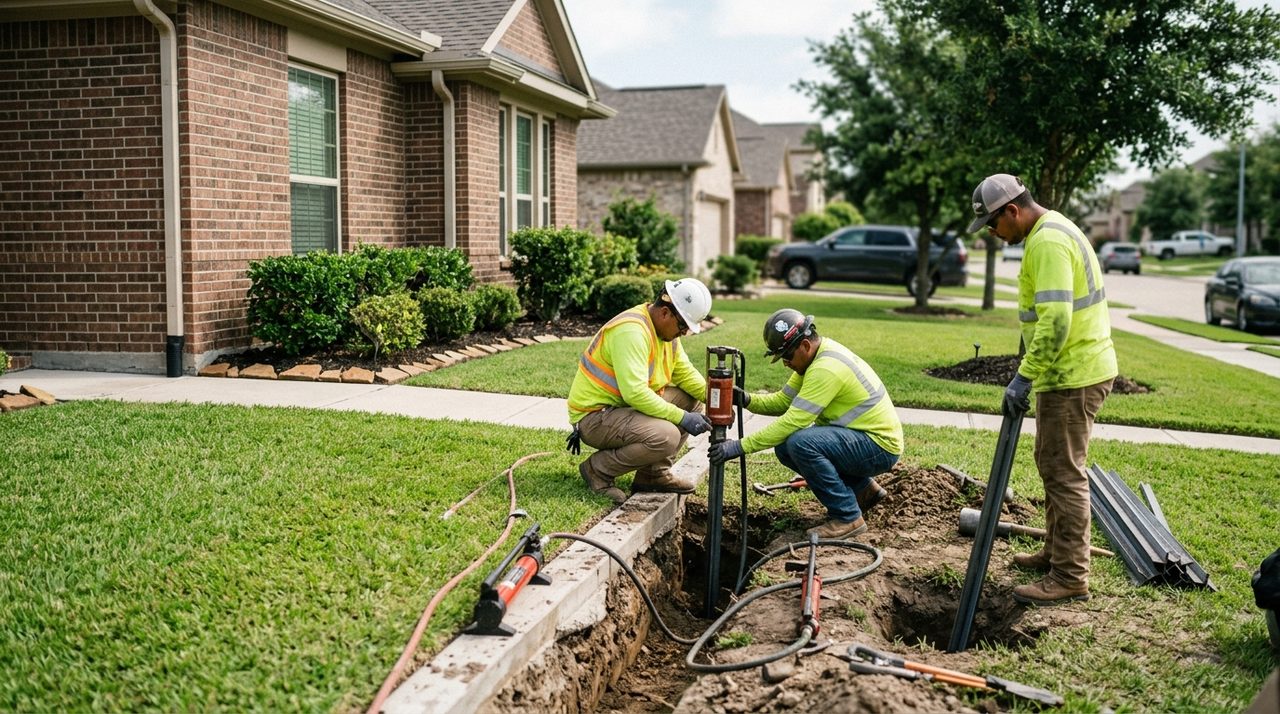
A qualified foundation contractor should probe the perimeter with a moisture meter and a thin rod to map void depth before quoting any repair. Prevention — running a soaker hose 18 inches from the foundation edge during dry months — is genuinely more cost-effective than piering, and a good pro will say so. If underpinning is warranted, steel push piers or helical piers (estimated $1,200–$1,800 per pier installed) are better suited to Fort Bend clay than legacy pressed concrete pilings.
Sources: Municipal permit office (see area profile), International Residential Code (as adopted by City of Houston)
Why it matters to you
In subdivisions like Fulshear Lakes, Pecan Ridge, and Polo Ranch, the HOA architectural committee controls exterior modifications including the perimeter trenching required for push-pier installation. Starting work without written HOA approval can trigger a stop-work notice and, in some cases, mandatory restoration of landscaping at the homeowner's expense — costs that can rival the repair itself. With Fulshear Lakes charging around $1,850 annually and enforcing deed restrictions actively, approval delays of two to four weeks are realistic and must be built into any repair timeline.
What a good pro does
Before contacting foundation contractors for bids, submit an architectural review request to your HOA with a site plan showing pier locations and trench dimensions. A reputable contractor will provide this documentation as part of their proposal package. Confirm in writing that HOA approval is in hand before scheduling the permit application with the City of Fulshear Building Department or Fort Bend County Engineering — whichever jurisdiction covers your parcel.
Sources: Local HOA / deed restrictions (see area profile), Municipal permit office (see area profile)
Why it matters to you
Fulshear's rapid annexation means a house on one side of a subdivision street may fall inside city limits while the house across the way sits in an unincorporated Fort Bend County ETJ area — two different permit offices, two different inspection schedules, and potentially different fee structures. A contractor permitted through Fort Bend County Engineering who inadvertently works inside city limits has created an unpermitted repair that will surface on the title search when you sell, potentially requiring re-inspection or corrective work.
What a good pro does
Ask any foundation contractor to confirm your parcel's exact jurisdiction before pulling a permit — Fort Bend County's parcel viewer and the City of Fulshear's GIS map can verify this in minutes. Foundation underpinning permits are required in both jurisdictions for structural repair work. Texas does not issue a standalone foundation-repair contractor license through TDLR, so verifying general liability insurance, workers' comp coverage, and permit-pulling track record in Fort Bend County specifically is the homeowner's primary protection.
Sources: Municipal permit office (see area profile), Texas Department of Licensing & Regulation
Why it matters to you
Fulshear's production builders and buyers have planted fast-growing live oaks, cedar elms, and Chinese tallow trees aggressively since 2010 to add shade to what were open clay fields. Many of these trees are now 15–25 feet tall with root systems extending two to three times the canopy radius — close enough to foundations on standard 60- to 70-foot-wide subdivision lots to draw soil moisture asymmetrically in summer. This localized drying on the tree side causes differential settlement that may not show up for another five to ten years but is already beginning on lots planted in the early 2010s.
What a good pro does
A foundation inspection on a Fulshear lot should include mapping tree locations relative to the slab perimeter and checking for asymmetric crack patterns (typically diagonal at door corners on the side nearest the largest trees). Root barriers — 18- to 24-inch vertical panels installed in a trench between the tree and the foundation — can redirect root growth without removing protected trees. If settlement has already occurred, helical piers ($1,500–$2,200 per pier, estimated) can reach load-bearing soil below the active clay layer; a good contractor will also recommend a consistent perimeter irrigation schedule to minimize future asymmetric drying.
Sources: International Residential Code (as adopted by City of Houston), Local HOA / deed restrictions (see area profile)
Hiring foundation repair in Fulshear? Fulshear is one of the fastest-growing communities in the Houston metro, dominated by post-2000 master-planned subdivisions with mandatory HOAs and rigorous deed restrictions. Homeowners here typically deal with newer construction systems but face strict architectural review for any exterior modifications. The mix of production homes and rural acreage tracts means service needs range from standard warranty-era maintenance to custom work on larger estate properties.
Building era
2000s–2020s (bulk of inventory); limited older housing in original town of Fulshear.
Typical style
Contemporary suburban production homes — brick and stone façades, 1- and 2-story detached single-family, mix of traditional, Texas Hill Country-inspired, and transitional elevations.
Foundations
Slab-on-grade (standard for post-2000 Fort Bend County production homes; older farmhouses or custom acreage homes may use pier-and-beam but are a small minority).
Common systems
Modern high-efficiency HVAC systems (14+ SEER), PEX or copper plumbing, 200-amp electrical panels, tankless or high-efficiency water heaters common in newer builds.
What that means for repairs
Most homes are under 20 years old, so major renovation is limited. Common projects include patio covers, outdoor kitchens, pool installations, and garage conversions — all typically requiring HOA architectural review and approval before work begins.
Permit jurisdiction
City of Fulshear Building Department for properties within city limits; Fort Bend County Engineering for unincorporated ETJ areas. Jurisdiction depends on exact property location.
HOA & deed restrictions
Most master-planned subdivisions (Weston Lakes, Fulshear Lakes, Pecan Ridge, Polo Ranch, and others) have mandatory HOAs with formal architectural review, deed restriction enforcement, and annual assessments (e.g., Fulshear Lakes charges ~$1,850/year including front yard maintenance). Non-HOA parcels exist on acreage tracts and older rural roads but are the minority of housing units.
Historic districts
No historic district designation confirmed. Fulshear is a rapidly growing area with almost entirely modern construction.
Contractor note
Contractors must verify whether a property falls within Fulshear city limits or unincorporated Fort Bend County, as permitting requirements and inspection processes differ. Nearly all subdivision work also requires prior HOA architectural committee approval before permits are pulled.
FEMA flood zone
FEMA Zone X (low flood risk) per official NFHL data. However, the broader Fulshear area sits between bayous and the Brazos River, so flood risk is highly location-specific — some parcels closer to waterways may carry different designations. Always verify FEMA FIRM panels for specific addresses.
Hurricane Harvey impact
No area-wide documentation confirms broad Harvey flooding across Fulshear subdivisions. Regional Harvey impact reports focus on Brazos River flooding near Simonton and Richmond rather than Fulshear master-planned communities. Marketing materials for major Fulshear subdivisions do not disclose Harvey flooding. However, no authoritative source definitively confirms zero impact for all Fulshear properties — for a specific address, check FEMA claims data and Fort Bend County floodplain records.
Heat & humidity load
New slab-on-grade construction on expansive Fort Bend County clay soils is subject to significant seasonal soil movement. Extended summer heat and drought cause soil shrinkage that can stress slab foundations and exterior hardscape. Proper irrigation of foundation perimeters is critical. High-efficiency HVAC systems in these larger homes (many 2,500–4,000+ sq ft) face heavy summer loads and benefit from annual pre-season maintenance.
Working with contractors here
Contractors in Fulshear primarily handle new-home warranty work, HVAC maintenance on modern high-efficiency systems, and outdoor living additions such as pools, covered patios, and outdoor kitchens. Because most homes are under 20 years old, major system replacements are uncommon, but foundation monitoring and minor slab repair due to expansive clay soils is a recurring need. HOA architectural review is a significant factor — contractors should advise homeowners to secure written HOA approval before scheduling exterior work, as non-compliant modifications can result in forced removal. The mix of production subdivisions and rural acreage means job scoping varies widely: subdivision work follows tight lot-line and setback constraints, while acreage properties may involve well/septic systems and longer material delivery logistics.
Local Tip
Always ask for a written estimate before work begins. Texas contractors are required to provide one on jobs over $1,000.
Fulshear is one of the fastest-growing communities in the Houston metro, dominated by post-2000 master-planned subdivisions with mandatory HOAs and rigorous deed restrictions. Homeowners here typically deal with newer construction systems but face strict architectural review for any exterior modifications. The mix of production homes and rural acreage tracts means service needs range from standard warranty-era maintenance to custom work on larger estate properties.
Source: U.S. Census Bureau, ACS 5-Year 2023
Most of Fulshear maps to FEMA Zone X (low mapped flood risk), but Houston's flash-flood reality means even low-risk blocks benefit from smart drainage and storm-hardened installs; risk climbs sharply on blocks nearest the Brazos River, where it varies parcel to parcel.
Source: FEMA National Flood Hazard Layer (NFHL). Flood zones vary by parcel — verify your individual FIRM panel.
Wind-driven rain during a hurricane can saturate soil on the windward side of your home while the leeward side stays dry, creating differential moisture conditions beneath your slab that show up as sticking doors weeks later in Fulshear, TX. Schedule a Zip-Level elevation reading after any named storm passes so a foundation professional can distinguish normal seasonal movement from storm-induced settlement requiring pier work. As a Fort Bend County community, Fulshear may follow county rather than City of Houston storm rebuild rules.
The May 2024 derecho caused structural racking in thousands of Houston homes, and racking places diagonal tension on slab corners that can widen existing hairline cracks into visible gaps in Fulshear, TX over the following weeks. Schedule a foundation survey within 30 days of any severe wind event to establish a post-storm baseline before summer drying compounds any movement. As a Fort Bend County community, Fulshear may follow county rather than City of Houston storm rebuild rules.
Winter Storm Uri's multi-day freeze caused Houston clay soils to go through freeze-thaw cycling not common in the region, and even low-flood-risk neighborhoods in Fulshear, TX saw new door-sticking and brick-step cracking appear in the spring following the storm. A post-winter Zip-Level survey establishes whether that movement is seasonal and self-correcting or progressive and in need of pier work before summer drying amplifies the differential. Because Fulshear drains toward the Brazos River, block-level runoff can differ sharply from the mapped zone.
Sources: FEMA National Flood Hazard Layer (NFHL), Ready.gov -- Hurricanes, CenterPoint Energy -- Storm Center, City of Houston -- Emergency Preparedness, Ready.gov -- Winter Weather, Harris County Flood Control District
Houston-specific estimators to plan your project before you call a pro. All results are planning estimates — a licensed local pro confirms the details on site.
Grouped by mature root aggression & water demand.
Trunk center to the nearest exterior wall.
The root zone likely reaches your foundation's soil during Houston's dry summers, when clay shrinks most. Watch for sticking doors and diagonal cracks, keep soil moisture even with a soaker hose during drought, and have a foundation pro evaluate if you see any movement.
Find a Houston foundation pro →This is a planning estimate only — actual requirements depend on an on-site assessment by a licensed Houston pro. Guidance is based on general species root behavior in expansive clay, not a soil test.
Disconnect & drain every outdoor hose bib
Remove hoses, drain the spigots, and cover each with an insulated faucet sock. Un-drained hose bibs are the #1 burst point in a Houston freeze.
Insulate exposed pipes in the attic & garage
Wrap any pipe in an unconditioned space (attic runs, garage walls) with foam sleeves. Houston homes rarely insulate these because they only matter a few nights a year — which is exactly why they burst.
Open cabinet doors & keep a pencil-width drip
On hard-freeze nights, open kitchen/bath cabinets so warm air reaches the pipes and let faucets on exterior walls drip to relieve pressure.
Protect the attic/garage water heater & its lines
An attic or garage tank sits in unconditioned space. Insulate the cold-inlet and hot-outlet lines and confirm the emergency drain pan is clear so a leak doesn't reach the ceiling.
This is a planning estimate only — actual requirements depend on an on-site assessment by a licensed Houston pro. If a pipe has already burst, shut off your main water supply and call a licensed Houston plumber immediately — freeze bursts flood fast.
Sources: Municipal permit office (see area profile)
Sources: Local HOA / deed restrictions (see area profile)