Closed
8830 Emnora Ln, Houston, TX 77080
Spring Branch's 1950s–1960s brick ranch homes sit on concrete slabs over Houston Black clay — one of the most expansive soil formations in North America — making foundation movement a recurring reality rather than a rare emergency in this West Houston neighborhood. Compounding the soil issue, the neighborhood's original cast-iron under-slab drain lines took a direct hit from Winter Storm Uri in 2021, and slow leaks from those pipes continue to destabilize slabs on blocks where repairs were only partially completed. This page walks Spring Branch homeowners through the specific combination of aging systems, clay soil, and City of Houston permitting that shapes every foundation repair decision here.
Ranked by verified Google rating × review volume × verification tier. How we rank →
Some highly-rated pros serve Spring Branch from nearby and may not keep a Spring Branch street address. Those are listed under "Also serving Spring Branch" with their real city and distance, so you always know where each business is based.
8830 Emnora Ln, Houston, TX 77080
9505 Yupondale Dr, Houston, TX 77080
2121 Brittmoore Rd Suite 5500-A, Houston, TX 77043
3815 Hollister Rd, Houston, TX 77080
Highly-rated pros based nearby who cover Spring Branch. Distance shown from the Spring Branch area.
Serving Spring Branch Based in Lazybrook / Timbergrove · 1.4 mi away
Serving Spring Branch Based in Lazybrook / Timbergrove · 1.4 mi away
Serving Spring Branch Based in Brookhollow · 2.7 mi away
Serving Spring Branch Based in Brookhollow · 2.8 mi away
Serving Spring Branch Based in Brookhollow · 2.9 mi away
Serving Spring Branch Based in Brookhollow · 3.5 mi away
Why it matters to you
Spring Branch's original 1950s–1960s homes were plumbed with cast-iron drain lines that run directly beneath their concrete slabs. Winter Storm Uri (February 2021) froze and fractured many of these pipes across the neighborhood, and a significant share received only surface-level interior cosmetic repairs — walls patched, floors refinished — while the cracked pipe beneath the slab was left in place. An undetected slow drain leak saturates the clay directly under the beam, causing localized heave followed by settlement as the soil structure deteriorates, a pattern that shows up in Spring Branch as diagonal drywall cracks radiating from door corners and sticky interior doors, often years after the original Uri event.
What a good pro does
Before signing any foundation repair contract, insist that the contractor recommend a hydrostatic plumbing pressure test — a licensed plumber (credentialed through TSBPE) pressurizes the drain system to identify leaks — which typically runs $250–$400 as a standalone test (est.). If a drain leak is confirmed under the slab, that pipe must be repaired or re-routed first; underpinning a slab sitting over an active leak will not hold. Any associated plumbing work under the slab requires a separate plumbing permit through the City of Houston's Houston Permitting Center, distinct from the foundation permit.
Sources: Texas State Board of Plumbing Examiners, City of Houston Permitting Center
Why it matters to you
Houston Black clay swells when wet and contracts sharply during dry stretches — the 2022–2023 La Niña drought years baked Spring Branch lots hard enough to pull soil away from slab edges, leaving perimeter voids that left the foundation's edge beam unsupported. When fall rains arrived, water rushed into those gaps rather than soaking in slowly, washing fines out from beneath the beam. On Spring Branch's original 1950s–1960s slabs, perimeter beams were typically shallower than post-1980 construction standards require, so differential movement between the supported interior and the unsupported perimeter edge produces the classic mid-wall horizontal crack pattern visible in the brick veneer on so many ranch homes along streets like Voss Road and Blalock.
What a good pro does
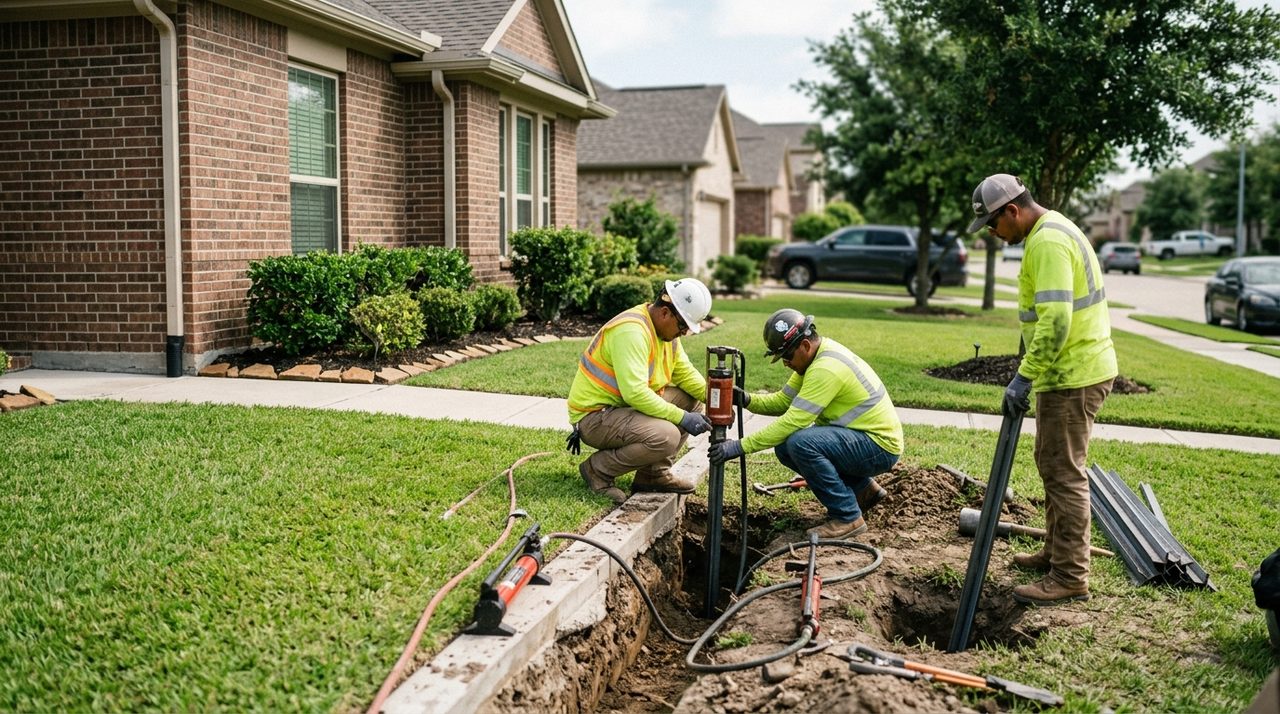
A reputable contractor will probe the perimeter for voids before recommending piers, and will discuss a soaker-hose or drip-irrigation program for the foundation perimeter during dry months — the most cost-effective prevention step available. When underpinning is warranted, steel push piers (roughly $1,200–$1,800 per pier installed, est.) or helical piers are more appropriate for Spring Branch's clay than legacy pressed concrete pilings, which have a documented failure history in this soil type. The City of Houston requires a foundation repair permit for underpinning work; confirm permit issuance through the Houston Permitting Center before work begins.
Sources: City of Houston Permitting Center, International Residential Code (as adopted by City of Houston)
Why it matters to you
Spring Branch's original 1950s lots were planted with fast-growing water oaks and Chinese tallow trees — both now at or past full canopy — whose root systems extend two to three times the canopy radius and aggressively extract soil moisture during dry months. On a typical Spring Branch ranch home, a large water oak within 15–20 feet of the south or west foundation face will draw down the clay on that side disproportionately, causing the slab to tilt toward the tree while the opposite perimeter remains elevated. The asymmetric crack pattern — diagonal runs at door corners on the tree side, stair-step cracks in the brick on that elevation — is a consistent fingerprint in this neighborhood that distinguishes tree-root depletion from general perimeter void formation.
What a good pro does
A thorough inspection should document the location and approximate canopy spread of every large tree within 30 feet of the foundation before any repair scope is written. Root barriers installed during the repair can slow re-depletion, but they require trenching close to the foundation — work that must be permitted through the City of Houston Permitting Center. Because some Spring Branch subdivisions (such as Spring Branch Estates and Spring Branch Oaks) carry recorded deed restrictions through Harris County Clerk records, homeowners should verify whether any tree-removal or root-management provisions apply to their specific plat before authorizing that scope.
Sources: City of Houston Permitting Center, Local HOA / deed restrictions (see area profile)
Why it matters to you
Spring Branch sits entirely within Houston city limits, so foundation underpinning — steel push piers, helical piers, or any structural void fill — requires a permit issued by the City of Houston's Houston Permitting Center, not a county or suburban municipality. This matters because the Spring Branch teardown-and-rebuild boom has brought in contractors whose permitting experience is primarily with Bellaire, Memorial Villages, or Harris County unincorporated rules, each of which has different fee schedules, inspection triggers, and documentation requirements than COH. Homeowners who allow a contractor to proceed without pulling a City of Houston permit face the risk of unpermitted work surfacing on a TREC seller-disclosure form at resale — a serious liability given Spring Branch's $640,000 median home value.
What a good pro does
Before any contract is signed, ask the contractor to confirm the specific City of Houston permit number and inspection sequence — typically a pre-pour or pre-backfill inspection for pier work — by checking directly with the Houston Permitting Center rather than relying on the contractor's verbal assurance. Texas does not issue a standalone state license for foundation repair contractors through TDLR, so the permit and the associated inspections are the primary consumer protection mechanism available. If any portion of the job involves re-routing under-slab plumbing, that scope requires a separate licensed plumber and a separate plumbing permit through COH.
Sources: City of Houston Permitting Center, Texas Department of Licensing & Regulation, Texas State Board of Plumbing Examiners
Hiring foundation repair in Spring Branch? Spring Branch's housing stock is dominated by 1950s–1960s single-family brick ranch homes on slab foundations, creating consistent demand for foundation repair, re-plumbing, and electrical upgrades. Ongoing teardown-and-rebuild activity means contractors regularly encounter both vintage systems and modern infill construction side by side. Deed restrictions and HOA rules vary subdivision by subdivision, so contractors should verify requirements on a per-project basis.
Building era
Primarily 1950s–1960s, with significant infill and townhome construction from the 2000s onward.
Typical style
One-story brick ranch houses (original stock); two-story contemporary/transitional homes and townhomes (infill).
Foundations
Predominantly concrete slab-on-grade for original 1950s–1960s homes; some pier-and-beam in earlier or custom structures. Confirm per-property via inspection or appraisal records.
Common systems
Original homes often have galvanized steel or cast-iron drain plumbing, older electrical panels (60–100 amp), and aging central HVAC units. Many properties have been partially updated but may still have legacy piping and wiring. Newer infill homes feature modern PEX plumbing, 200-amp panels, and high-efficiency HVAC systems.
What that means for repairs
Teardown-and-rebuild activity is very common as lot values support new construction. Remaining original homes frequently undergo whole-house renovations including re-plumbing (replacing galvanized lines), electrical panel upgrades, HVAC replacement, and kitchen/bath remodels. Foundation leveling is a recurring need on slab homes due to expansive clay soils.
Permit jurisdiction
City of Houston — Houston Permitting Center (Spring Branch is within Houston city limits).
HOA & deed restrictions
No single area-wide mandatory HOA. Voluntary civic associations (e.g., Spring Branch Civic Association, Spring Branch Oaks Civic Association) cover much of the older residential area. Some platted subdivisions have mandatory HOAs with recorded deed restrictions and mandatory assessments (e.g., Spring Branch Estates, Spring Branch Estates II). At least six mandatory HOAs are registered in the broader Spring Branch area. Deed restrictions are common at the subdivision level but vary by plat—check Harris County Clerk records for each property.
Historic districts
No City of Houston historic district designation confirmed.
Contractor note
Because deed restrictions and HOA requirements vary by subdivision, contractors should confirm any architectural review, fence/accessory structure, and material restrictions before beginning work. The City of Houston permitting process applies to all structural, electrical, plumbing, and mechanical work.
FEMA flood zone
FEMA Zone X (low flood risk) per the official NFHL API. However, Spring Branch is bisected by several tributaries of White Oak Bayou and Spring Branch Creek, and localized street flooding can still occur during heavy rain events. Property-level flood risk should be verified, especially for lots near drainage channels.
Hurricane Harvey impact
Research did not return specific Harvey damage documentation for this civic-association-defined area of Spring Branch. Broader media and City of Houston reporting indicate that portions of the Spring Branch area experienced significant flooding during Harvey, particularly near bayou tributaries and low-lying streets. Homeowners and contractors should check individual property flood claims history through FEMA and the Harris County Flood Control District for site-specific impact data.
Heat & humidity load
Extended Houston summers with sustained 95°F+ temperatures and high humidity stress aging HVAC systems and accelerate attic insulation degradation in 1950s–1960s ranch homes. Slab-on-grade foundations on expansive clay soils are vulnerable to differential settlement during summer drought cycles. Exterior paint and caulking on older brick veneer homes deteriorate quickly in UV-intense conditions.
Working with contractors here
The most common work in Spring Branch involves updating the mechanical and plumbing systems in 1950s–1960s ranch homes—re-plumbing galvanized supply lines, replacing cast-iron drains, upgrading electrical panels, and installing modern HVAC systems. Foundation repair is a perennial need due to expansive clay soils and slab-on-grade construction. Teardown-and-rebuild projects are frequent, requiring contractors familiar with City of Houston new-construction permitting and lot-specific deed restriction compliance. For renovation jobs on older homes, contractors should budget for potential asbestos abatement (siding, flooring, duct insulation) and lead paint remediation. Scoping should account for the wide variation between unrenovated originals and partially updated homes on the same block.
Local Tip
Always ask for a written estimate before work begins. Texas contractors are required to provide one on jobs over $1,000.
Spring Branch's housing stock is dominated by 1950s–1960s single-family brick ranch homes on slab foundations, creating consistent demand for foundation repair, re-plumbing, and electrical upgrades. Ongoing teardown-and-rebuild activity means contractors regularly encounter both vintage systems and modern infill construction side by side. Deed restrictions and HOA rules vary subdivision by subdivision, so contractors should verify requirements on a per-project basis.
Source: U.S. Census Bureau, ACS 5-Year 2023
Most of Spring Branch maps to FEMA Zone X (low mapped flood risk), but Houston's flash-flood reality means even low-risk blocks benefit from smart drainage and storm-hardened installs.
Source: FEMA National Flood Hazard Layer (NFHL). Flood zones vary by parcel — verify your individual FIRM panel.
Houston's flash-flood reality means even low-mapped-risk areas like Spring Branch can see sheet flow accumulate against a foundation during a slow-moving Gulf system, so verify that your perimeter drainage is clear and properly sloped before hurricane season opens. A TDLR-licensed foundation contractor can add or reposition surface drains to intercept runoff before it softens the clay bearing layer beneath your slab. In-city Spring Branch work falls under City of Houston floodplain and permitting rules.
Hail itself does not crack a concrete foundation, but the insurance repair process — contractors dropping equipment, vibrating compactors near the structure — can disturb marginally stable piers in Spring Branch. Coordinate a brief foundation check with a TDLR-licensed contractor before and after any major roof or exterior repair project that involves heavy equipment operating near your home. Confirm the current FEMA panel for your Spring Branch parcel — the area maps to Zone X, but adjacent lots can differ.
In Spring Branch, where mapped flood risk is low, the primary post-freeze foundation threat is not surface water but slab-leak-driven soil saturation — Uri 2021 caused widespread pipe failures that fed water silently under slabs for days before homeowners noticed. After any hard freeze, have a plumber pressure-test your lines first, then schedule a foundation elevation check if any under-slab leak is confirmed. With a median build year of 1978, the older building stock here is more exposed to hard-freeze damage than newer construction. Confirm the current FEMA panel for your Spring Branch parcel — the area maps to Zone X, but adjacent lots can differ.
Sources: FEMA National Flood Hazard Layer (NFHL), Ready.gov -- Hurricanes, CenterPoint Energy -- Storm Center, City of Houston -- Emergency Preparedness, Ready.gov -- Winter Weather, Harris County Flood Control District
Houston-specific estimators to plan your project before you call a pro. All results are planning estimates — a licensed local pro confirms the details on site.
Grouped by mature root aggression & water demand.
Trunk center to the nearest exterior wall.
The root zone likely reaches your foundation's soil during Houston's dry summers, when clay shrinks most. Watch for sticking doors and diagonal cracks, keep soil moisture even with a soaker hose during drought, and have a foundation pro evaluate if you see any movement.
Find a Houston foundation pro →This is a planning estimate only — actual requirements depend on an on-site assessment by a licensed Houston pro. Guidance is based on general species root behavior in expansive clay, not a soil test.
Disconnect & drain every outdoor hose bib
Remove hoses, drain the spigots, and cover each with an insulated faucet sock. Un-drained hose bibs are the #1 burst point in a Houston freeze.
Insulate exposed pipes in the attic & garage
Wrap any pipe in an unconditioned space (attic runs, garage walls) with foam sleeves. Houston homes rarely insulate these because they only matter a few nights a year — which is exactly why they burst.
Open cabinet doors & keep a pencil-width drip
On hard-freeze nights, open kitchen/bath cabinets so warm air reaches the pipes and let faucets on exterior walls drip to relieve pressure.
Protect the attic/garage water heater & its lines
An attic or garage tank sits in unconditioned space. Insulate the cold-inlet and hot-outlet lines and confirm the emergency drain pan is clear so a leak doesn't reach the ceiling.
This is a planning estimate only — actual requirements depend on an on-site assessment by a licensed Houston pro. If a pipe has already burst, shut off your main water supply and call a licensed Houston plumber immediately — freeze bursts flood fast.
Sources: City of Houston Permitting CenterMunicipal permit office (see area profile)
Sources: Local HOA / deed restrictions (see area profile)