Closed
Serving Fulshear Based in Richmond · 4.5 mi away
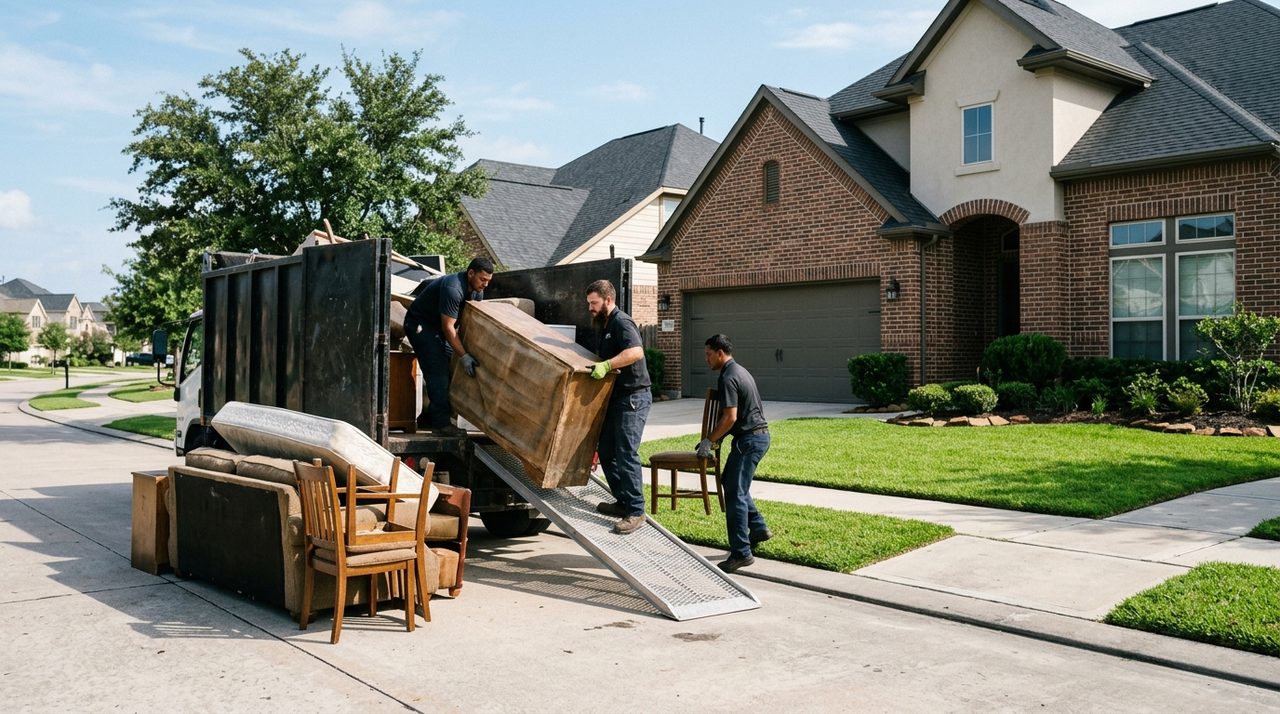
Fulshear's explosive post-2000 growth has produced a sea of master-planned subdivisions — Weston Lakes, Fulshear Lakes, Pecan Ridge, Polo Ranch — where mandatory HOAs govern everything from fence colors to how long debris can sit at the curb, making junk removal a process that requires coordination well beyond scheduling a truck. With a census median build year of 2015 and a median home value of $546,200, most removal calls here aren't gut-outs of century-old plaster but rather outdoor-living project overflows, storm-knocked woody debris, and wave replacements of construction-era appliances hitting the end of their warranty cycles. This page lays out the four removal realities that specifically shape cost, timing, and HOA compliance in Fulshear.
Ranked by verified Google rating × review volume × verification tier. How we rank →
Some highly-rated pros serve Fulshear from nearby and may not keep a Fulshear street address. Those are listed under "Also serving Fulshear" with their real city and distance, so you always know where each business is based.
Highly-rated pros based nearby who cover Fulshear. Distance shown from the Fulshear area.
Serving Fulshear Based in Richmond · 4.5 mi away
Serving Fulshear Based in Richmond · 5.3 mi away
Serving Fulshear Based in Katy · 5.5 mi away
Serving Fulshear Based in Katy · 6.4 mi away
Why it matters to you
Every major Fulshear master-planned community — Weston Lakes, Fulshear Lakes, Pecan Ridge, Polo Ranch — runs a formal architectural review committee with deed restrictions that typically limit curbside debris staging to 24–48 hours and may outright prohibit roll-off containers in driveways without prior written HOA approval. Fines for violations land on the homeowner, not the hauler, and assessments like Fulshear Lakes' roughly $1,850-per-year structure mean you're already paying for HOA enforcement — ignoring a staging rule adds cost on top of that.
What a good pro does
A junk removal crew experienced in Fort Bend HOA communities will ask for your subdivision name and CC&Rs before booking, confirm the debris window the HOA permits, and schedule a same-day load-and-go if a roll-off dumpster isn't allowed curbside. For large clearouts requiring multiple trips, a reputable hauler will coordinate staggered pickups so debris never sits longer than your HOA allows. Get the HOA approval in writing — email confirmation from your architectural review committee is sufficient — before the truck arrives.
Sources: Local HOA / deed restrictions (see area profile), Municipal permit office (see area profile)
Why it matters to you
Because Fulshear's production-home inventory is mostly under 20 years old, the renovation boom here centers on outdoor additions — pool installations, covered patios, outdoor kitchens, pergolas — rather than interior gut-outs. That work generates concrete rubble from cracked or repositioned slab sections, old wood framing, coping stones, and construction debris that contractors frequently leave for homeowners to handle separately. Fort Bend County's expansive Beaumont clay shrinks and swells under those slab sections, accelerating cracking on patios as young as five to eight years old, so replacement cycles are coming earlier than homeowners expect.
What a good pro does
Concrete and C&D debris cannot go in a standard household-junk truck without triggering weight surcharges and potential violations of TCEQ municipal solid waste transporter rules — disposal must occur at a TCEQ-permitted facility, and concrete is typically billed separately at an estimated $60–$120 per ton above base rates. A qualified hauler will weigh or visually estimate your rubble before quoting, quote concrete separately from any wood or general debris, and confirm that disposal is going to a TCEQ-permitted transfer station or C&D facility rather than a general landfill. Ask for that confirmation in writing.
Sources: Texas Commission on Environmental Quality, Local HOA / deed restrictions (see area profile)
Why it matters to you
Fulshear's newer subdivisions planted thousands of fast-growing live oaks, cedar elms, and crape myrtles that were still maturing when the May 2024 derecho (100-plus mph gusts) and Hurricane Beryl (July 2024) moved through the Houston metro. Tree services cut and section downed trees but routinely leave the resulting slash piles, fence pickets, and damaged pergola framing for homeowners to handle separately. City of Fulshear and Fort Bend County bulk-collection schedules are not designed for post-storm surge volume, leaving residents dependent on private haulers for what would otherwise be a free curbside pickup in a larger city with more frequent routes.
What a good pro does
Woody debris is generally lighter per cubic yard than concrete but bulky — a full truckload of slash and fencing runs an estimated $400–$650 — and haulers who know Fulshear's HOA restrictions won't stage a debris pile across multiple days. The most efficient approach is scheduling removal immediately after the tree crew finishes, treating woody debris and any damaged outbuilding framing as separate line items from general household junk so you can confirm TCEQ-compliant disposal routing for each material type. Confirm your hauler's TCEQ municipal solid waste transporter registration before booking.
Sources: Texas Commission on Environmental Quality, Local HOA / deed restrictions (see area profile), Municipal permit office (see area profile)
Why it matters to you
Fulshear's production subdivisions were built in concentrated phases — large sections of Polo Ranch, Pecan Ridge, and Fulshear Lakes all went up within two to four year windows in the mid-2010s. That means hundreds of homes share nearly identical system ages, and when a component class (tankless water heaters installed in 2014–2016, or 14-SEER HVAC units from 2012–2015) begins failing, neighborhoods see replacement waves rather than scattered individual swaps. Uri's February 2021 hard freeze accelerated failure timelines on water heaters and HVAC air handlers across the metro, and Fulshear was not exempt. Slab-on-grade construction means there is no basement staging area — every old unit comes through the living space or a side-gate access.
What a good pro does
A junk removal crew handling appliance haul-away in Fulshear should confirm gate width and route before the job — side-yard access in production-home lots is often exactly 36 inches, and a compressor unit or large air handler may require door removal or creative angling. Single-appliance haul-away in the Houston metro runs an estimated $75–$150 for a water heater or refrigerator; HVAC compressor removal may run higher due to weight. Confirm the hauler disposes of refrigerant-containing units at a TCEQ-permitted facility, as improper refrigerant release violates federal EPA rules — not just state ones — and the homeowner can bear secondary liability if the disposal chain is audited.
Sources: Texas Commission on Environmental Quality, EPA Lead Renovation, Repair and Painting (RRP) Rule, Municipal permit office (see area profile)
Hiring junk removal in Fulshear? Fulshear is one of the fastest-growing communities in the Houston metro, dominated by post-2000 master-planned subdivisions with mandatory HOAs and rigorous deed restrictions. Homeowners here typically deal with newer construction systems but face strict architectural review for any exterior modifications. The mix of production homes and rural acreage tracts means service needs range from standard warranty-era maintenance to custom work on larger estate properties.
Building era
2000s–2020s (bulk of inventory); limited older housing in original town of Fulshear.
Typical style
Contemporary suburban production homes — brick and stone façades, 1- and 2-story detached single-family, mix of traditional, Texas Hill Country-inspired, and transitional elevations.
Foundations
Slab-on-grade (standard for post-2000 Fort Bend County production homes; older farmhouses or custom acreage homes may use pier-and-beam but are a small minority).
Common systems
Modern high-efficiency HVAC systems (14+ SEER), PEX or copper plumbing, 200-amp electrical panels, tankless or high-efficiency water heaters common in newer builds.
What that means for repairs
Most homes are under 20 years old, so major renovation is limited. Common projects include patio covers, outdoor kitchens, pool installations, and garage conversions — all typically requiring HOA architectural review and approval before work begins.
Permit jurisdiction
City of Fulshear Building Department for properties within city limits; Fort Bend County Engineering for unincorporated ETJ areas. Jurisdiction depends on exact property location.
HOA & deed restrictions
Most master-planned subdivisions (Weston Lakes, Fulshear Lakes, Pecan Ridge, Polo Ranch, and others) have mandatory HOAs with formal architectural review, deed restriction enforcement, and annual assessments (e.g., Fulshear Lakes charges ~$1,850/year including front yard maintenance). Non-HOA parcels exist on acreage tracts and older rural roads but are the minority of housing units.
Historic districts
No historic district designation confirmed. Fulshear is a rapidly growing area with almost entirely modern construction.
Contractor note
Contractors must verify whether a property falls within Fulshear city limits or unincorporated Fort Bend County, as permitting requirements and inspection processes differ. Nearly all subdivision work also requires prior HOA architectural committee approval before permits are pulled.
FEMA flood zone
FEMA Zone X (low flood risk) per official NFHL data. However, the broader Fulshear area sits between bayous and the Brazos River, so flood risk is highly location-specific — some parcels closer to waterways may carry different designations. Always verify FEMA FIRM panels for specific addresses.
Hurricane Harvey impact
No area-wide documentation confirms broad Harvey flooding across Fulshear subdivisions. Regional Harvey impact reports focus on Brazos River flooding near Simonton and Richmond rather than Fulshear master-planned communities. Marketing materials for major Fulshear subdivisions do not disclose Harvey flooding. However, no authoritative source definitively confirms zero impact for all Fulshear properties — for a specific address, check FEMA claims data and Fort Bend County floodplain records.
Heat & humidity load
New slab-on-grade construction on expansive Fort Bend County clay soils is subject to significant seasonal soil movement. Extended summer heat and drought cause soil shrinkage that can stress slab foundations and exterior hardscape. Proper irrigation of foundation perimeters is critical. High-efficiency HVAC systems in these larger homes (many 2,500–4,000+ sq ft) face heavy summer loads and benefit from annual pre-season maintenance.
Working with contractors here
Contractors in Fulshear primarily handle new-home warranty work, HVAC maintenance on modern high-efficiency systems, and outdoor living additions such as pools, covered patios, and outdoor kitchens. Because most homes are under 20 years old, major system replacements are uncommon, but foundation monitoring and minor slab repair due to expansive clay soils is a recurring need. HOA architectural review is a significant factor — contractors should advise homeowners to secure written HOA approval before scheduling exterior work, as non-compliant modifications can result in forced removal. The mix of production subdivisions and rural acreage means job scoping varies widely: subdivision work follows tight lot-line and setback constraints, while acreage properties may involve well/septic systems and longer material delivery logistics.
Local Tip
Always ask for a written estimate before work begins. Texas contractors are required to provide one on jobs over $1,000.
Fulshear is one of the fastest-growing communities in the Houston metro, dominated by post-2000 master-planned subdivisions with mandatory HOAs and rigorous deed restrictions. Homeowners here typically deal with newer construction systems but face strict architectural review for any exterior modifications. The mix of production homes and rural acreage tracts means service needs range from standard warranty-era maintenance to custom work on larger estate properties.
Source: U.S. Census Bureau, ACS 5-Year 2023
Most of Fulshear maps to FEMA Zone X (low mapped flood risk), but Houston's flash-flood reality means even low-risk blocks benefit from smart drainage and storm-hardened installs; risk climbs sharply on blocks nearest the Brazos River, where it varies parcel to parcel.
Source: FEMA National Flood Hazard Layer (NFHL). Flood zones vary by parcel — verify your individual FIRM panel.
Sources: Texas Commission on Environmental QualityMunicipal permit office (see area profile)
Sources: Local HOA / deed restrictions (see area profile)
Sources: EPA Lead Renovation, Repair and Painting (RRP) Rule
Sources: Texas Commission on Environmental QualityLocal HOA / deed restrictions (see area profile)