Closed
Serving Fulshear Based in Katy · 3.5 mi away
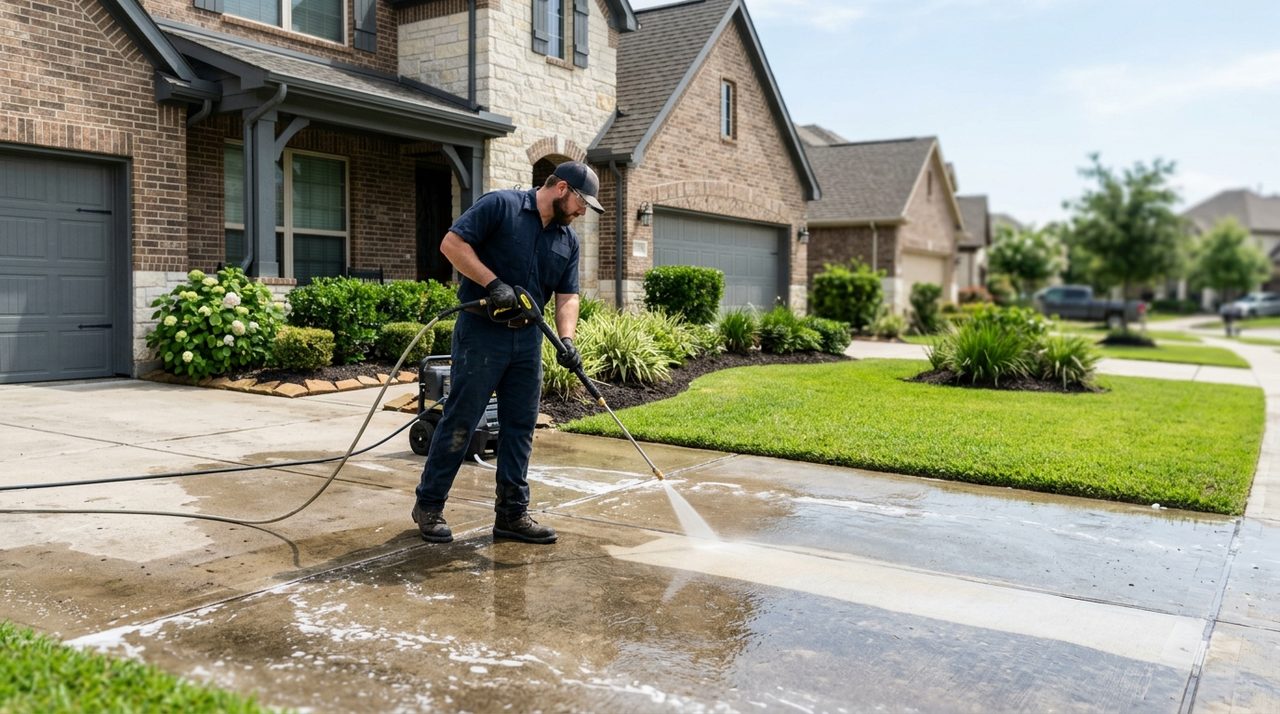
Fulshear's post-2000 master-planned subdivisions — Weston Lakes, Fulshear Lakes, Pecan Ridge, Polo Ranch, and others — present a specific pressure-washing reality: homes are newer (median year built 2015), but brick-and-stone façades on slab-on-grade foundations over Fort Bend County's expansive clay soil accumulate mineral staining and mold faster than most homeowners expect. Add mandatory HOA architectural review committees that issue written violation notices for algae-stained driveways and discolored fences, and routine exterior cleaning becomes a compliance matter, not just a cosmetic one.
Ranked by verified Google rating × review volume × verification tier. How we rank →
Some highly-rated pros serve Fulshear from nearby and may not keep a Fulshear street address. Those are listed under "Also serving Fulshear" with their real city and distance, so you always know where each business is based.
Highly-rated pros based nearby who cover Fulshear. Distance shown from the Fulshear area.
Serving Fulshear Based in Katy · 3.5 mi away
Serving Fulshear Based in Katy · 4.9 mi away
Serving Fulshear Based in Katy · 5.3 mi away
Serving Fulshear Based in Katy · 5.5 mi away
Serving Fulshear Based in Katy · 5.6 mi away
Serving Fulshear Based in Cinco Ranch · 9.1 mi away
Why it matters to you
Virtually every production subdivision in Fulshear — Fulshear Lakes (~$1,850/year in assessments including front yard maintenance), Polo Ranch, Pecan Ridge, and others — operates with active architectural review committees that issue written notices for algae-stained driveways, green-tinted concrete, and discolored fence panels. Cure windows can be as short as 30 days, meaning a homeowner who waits until staining is obvious may already be on a compliance clock. Because most Fulshear homes were built between 2005 and 2022, their concrete driveways and brick-mortar joints are entering the 5–15 year window when Gloeocapsa magma black algae and green mold colonize most aggressively in Fort Bend County's high-humidity environment.
What a good pro does
A thorough wash operator will document the violation notice details and match the cleaning method to the HOA's CC&Rs — some Fulshear communities specifically prohibit high-pressure application on roofing materials, so the pro must confirm whether a soft-wash (under 500 PSI with chemical dwell time) is required on roof lines and upper brick courses. After cleaning, a post-treatment biocide application to driveways and concrete flat work extends the clean appearance through the next HOA inspection cycle. Texas does not license pressure washing as a standalone trade, but operators applying algaecide products at regulated concentrations may need a Texas Department of Agriculture (TDA) pesticide applicator credential — confirm this before any biocide is applied.
Sources: Local HOA / deed restrictions (see area profile)
Why it matters to you
Fulshear sits on Fort Bend County's Houston Black clay — the same expansive Beaumont-series soil responsible for the foundation monitoring that is a recurring maintenance reality across the area. On slab-on-grade homes (the standard for every post-2000 production build here), seasonal clay shrink-swell cycles wick mineral salts upward through the concrete slab perimeter and into driveways, patios, and the mortar joints of the brick-and-stone façades that dominate Fulshear's streetscapes. The result is white efflorescence blooms at the slab edge and red-clay mud staining on flatwork — staining that standard cold-water rinsing cannot remove and that looks especially stark against the lighter-colored decorative concrete common in Fulshear's outdoor living additions (patios, pool decks, outdoor kitchen pads).
What a good pro does
Effective treatment requires a low-pH efflorescence cleaner applied as a chemical pre-treatment, followed by moderate-pressure hot-water rinse — not a cold-water blast that can drive salts deeper into the pore structure. For brick and stone mortar joints, the operator should keep pressure below 1,000 PSI and keep the wand angle oblique to avoid eroding the mortar. Homeowners planning to add a patio cover or outdoor kitchen (common Fulshear renovation projects) should schedule a pre-construction wash and document the slab-edge condition, since clean surfaces make it easier to spot any new efflorescence after the addition is complete. No City of Fulshear or Fort Bend County permit is required for the wash itself.
Sources: International Residential Code (as adopted by City of Houston)
Why it matters to you
Most Fulshear homes built since 2005 carry architectural asphalt shingles that still have active manufacturer warranties — but those warranties are typically voided by high-pressure washing above 500 PSI, and many homeowners are unaware of this restriction. Houston's humidity means Gloeocapsa magma black streaking appears on roof planes within 2–4 years of installation even on newer shingles, and Fulshear's HOA committees do cite roof discoloration in violation notices. Getting the roof cleaned via the wrong method — a pressure washer rather than a low-pressure soft-wash — can cost the homeowner a warranty claim worth thousands of dollars on a relatively new roof.
What a good pro does
The correct method is a sodium hypochlorite-based soft-wash delivered at under 100 PSI from the ridge downward — the same approach recommended by the Asphalt Roofing Manufacturers Association (ARMA) and consistent with most shingle warranty language. The chemical dwell time does the cleaning work; rinse water removes residue without mechanical abrasion. Homeowners should ask the operator to document the PSI used and confirm in writing that the method preserves manufacturer warranty coverage. No City of Fulshear or Fort Bend County permit is required for roof washing, but if a biocide is used, verify the operator's TDA pesticide applicator status as noted under Texas licensing rules.
Sources: Local HOA / deed restrictions (see area profile), International Residential Code (as adopted by City of Houston)
Why it matters to you
The production subdivisions built across Fulshear since 2010 predominantly use pine privacy fencing on tight lot-line spacing — and Fort Bend County's combination of 100°F+ summers, frequent Gulf moisture, and high termite pressure means untreated pine grays and develops surface mold within 12–18 months. Because Fulshear lots are newer, many homeowners are now hitting the first major fence-maintenance window (staining or sealing at years 2–4) and need a pressure wash as the required prep step. Over-pressuring weathered pine — anything above 1,000–1,200 PSI — splinters the grain and creates a rough surface that holds stain unevenly, compounding the problem.
What a good pro does
For fence prep washing, a qualified operator uses a downstream chemical injector to apply a wood brightener or mild detergent at low pressure, lets it dwell, then rinses at 600–900 PSI with a wide-fan tip at consistent distance from the boards. This removes gray oxidation and mold spores without raising the grain. Because Fulshear's HOAs often govern fence color and finish (many communities specify natural or semi-transparent stains only), the homeowner should submit the stain product and color to the architectural review committee for written approval before staining — the wash is the first step, but committee approval must come first to avoid a forced re-do. TCEQ rules apply to wash water containing wood brightener or cleaner chemicals: keep it off storm drain inlets and allow it to absorb into the lawn or landscaped areas rather than sheet-flowing to the curb.
Sources: Local HOA / deed restrictions (see area profile), Texas Commission on Environmental Quality
Hiring pressure washing in Fulshear? Fulshear is one of the fastest-growing communities in the Houston metro, dominated by post-2000 master-planned subdivisions with mandatory HOAs and rigorous deed restrictions. Homeowners here typically deal with newer construction systems but face strict architectural review for any exterior modifications. The mix of production homes and rural acreage tracts means service needs range from standard warranty-era maintenance to custom work on larger estate properties.
Building era
2000s–2020s (bulk of inventory); limited older housing in original town of Fulshear.
Typical style
Contemporary suburban production homes — brick and stone façades, 1- and 2-story detached single-family, mix of traditional, Texas Hill Country-inspired, and transitional elevations.
Foundations
Slab-on-grade (standard for post-2000 Fort Bend County production homes; older farmhouses or custom acreage homes may use pier-and-beam but are a small minority).
Common systems
Modern high-efficiency HVAC systems (14+ SEER), PEX or copper plumbing, 200-amp electrical panels, tankless or high-efficiency water heaters common in newer builds.
What that means for repairs
Most homes are under 20 years old, so major renovation is limited. Common projects include patio covers, outdoor kitchens, pool installations, and garage conversions — all typically requiring HOA architectural review and approval before work begins.
Permit jurisdiction
City of Fulshear Building Department for properties within city limits; Fort Bend County Engineering for unincorporated ETJ areas. Jurisdiction depends on exact property location.
HOA & deed restrictions
Most master-planned subdivisions (Weston Lakes, Fulshear Lakes, Pecan Ridge, Polo Ranch, and others) have mandatory HOAs with formal architectural review, deed restriction enforcement, and annual assessments (e.g., Fulshear Lakes charges ~$1,850/year including front yard maintenance). Non-HOA parcels exist on acreage tracts and older rural roads but are the minority of housing units.
Historic districts
No historic district designation confirmed. Fulshear is a rapidly growing area with almost entirely modern construction.
Contractor note
Contractors must verify whether a property falls within Fulshear city limits or unincorporated Fort Bend County, as permitting requirements and inspection processes differ. Nearly all subdivision work also requires prior HOA architectural committee approval before permits are pulled.
FEMA flood zone
FEMA Zone X (low flood risk) per official NFHL data. However, the broader Fulshear area sits between bayous and the Brazos River, so flood risk is highly location-specific — some parcels closer to waterways may carry different designations. Always verify FEMA FIRM panels for specific addresses.
Hurricane Harvey impact
No area-wide documentation confirms broad Harvey flooding across Fulshear subdivisions. Regional Harvey impact reports focus on Brazos River flooding near Simonton and Richmond rather than Fulshear master-planned communities. Marketing materials for major Fulshear subdivisions do not disclose Harvey flooding. However, no authoritative source definitively confirms zero impact for all Fulshear properties — for a specific address, check FEMA claims data and Fort Bend County floodplain records.
Heat & humidity load
New slab-on-grade construction on expansive Fort Bend County clay soils is subject to significant seasonal soil movement. Extended summer heat and drought cause soil shrinkage that can stress slab foundations and exterior hardscape. Proper irrigation of foundation perimeters is critical. High-efficiency HVAC systems in these larger homes (many 2,500–4,000+ sq ft) face heavy summer loads and benefit from annual pre-season maintenance.
Working with contractors here
Contractors in Fulshear primarily handle new-home warranty work, HVAC maintenance on modern high-efficiency systems, and outdoor living additions such as pools, covered patios, and outdoor kitchens. Because most homes are under 20 years old, major system replacements are uncommon, but foundation monitoring and minor slab repair due to expansive clay soils is a recurring need. HOA architectural review is a significant factor — contractors should advise homeowners to secure written HOA approval before scheduling exterior work, as non-compliant modifications can result in forced removal. The mix of production subdivisions and rural acreage means job scoping varies widely: subdivision work follows tight lot-line and setback constraints, while acreage properties may involve well/septic systems and longer material delivery logistics.
Local Tip
Always ask for a written estimate before work begins. Texas contractors are required to provide one on jobs over $1,000.
Fulshear is one of the fastest-growing communities in the Houston metro, dominated by post-2000 master-planned subdivisions with mandatory HOAs and rigorous deed restrictions. Homeowners here typically deal with newer construction systems but face strict architectural review for any exterior modifications. The mix of production homes and rural acreage tracts means service needs range from standard warranty-era maintenance to custom work on larger estate properties.
Source: U.S. Census Bureau, ACS 5-Year 2023
Most of Fulshear maps to FEMA Zone X (low mapped flood risk), but Houston's flash-flood reality means even low-risk blocks benefit from smart drainage and storm-hardened installs; risk climbs sharply on blocks nearest the Brazos River, where it varies parcel to parcel.
Source: FEMA National Flood Hazard Layer (NFHL). Flood zones vary by parcel — verify your individual FIRM panel.
Sources: Local HOA / deed restrictions (see area profile)
Sources: Local HOA / deed restrictions (see area profile)