Open Now
Serving Brookhollow Based in Spring Branch · 2.4 mi away
Brookhollow's 1960s–1980s slab-on-grade ranch homes along the US-290 corridor carry a specific water-damage profile: aging cast-iron drain lines prone to backups, original flex ductwork that absorbs moisture like a sponge, and Houston Black clay soil that holds water against slab edges long after any storm passes. Even sitting in FEMA Zone X, these homes are not immune to flash-flood intrusion or the slow-motion damage caused by decades of deferred maintenance on original plumbing and HVAC systems. Understanding how water behaves inside a mid-century Houston slab home — and how City of Houston permitting requirements shape the restoration timeline — is the practical knowledge this page delivers.
Ranked by verified Google rating × review volume × verification tier. How we rank →
Some highly-rated pros serve Brookhollow from nearby and may not keep a Brookhollow street address. Those are listed under "Also serving Brookhollow" with their real city and distance, so you always know where each business is based.
Highly-rated pros based nearby who cover Brookhollow. Distance shown from the Brookhollow area.
Serving Brookhollow Based in Spring Branch · 2.4 mi away
Serving Brookhollow Based in Spring Branch · 2.5 mi away
Serving Brookhollow Based in Acres Homes · 2.7 mi away
Serving Brookhollow Based in Spring Branch · 2.9 mi away
Serving Brookhollow Based in Spring Branch · 3 mi away
Serving Brookhollow Based in Spring Branch · 3.5 mi away
Serving Brookhollow Based in Jersey Village · 3.6 mi away
Serving Brookhollow Based in Tanglewood · 3.7 mi away
Serving Brookhollow Based in Spring Branch · 3.7 mi away
Serving Brookhollow Based in Spring Branch · 3.7 mi away
Why it matters to you
Brookhollow's homes were built directly on Houston Black clay, the same expansive soil that underlies most of the US-290 corridor. When any water event — a cast-iron drain backup, a burst supply line, or a flash-flood intrusion — saturates the ground, this clay holds moisture against the slab perimeter for weeks. Homeowners often assume the problem is resolved once visible water is gone, but the slab edge and bottom plates are still actively absorbing moisture, creating conditions for mold growth behind intact drywall without any outward sign.
What a good pro does
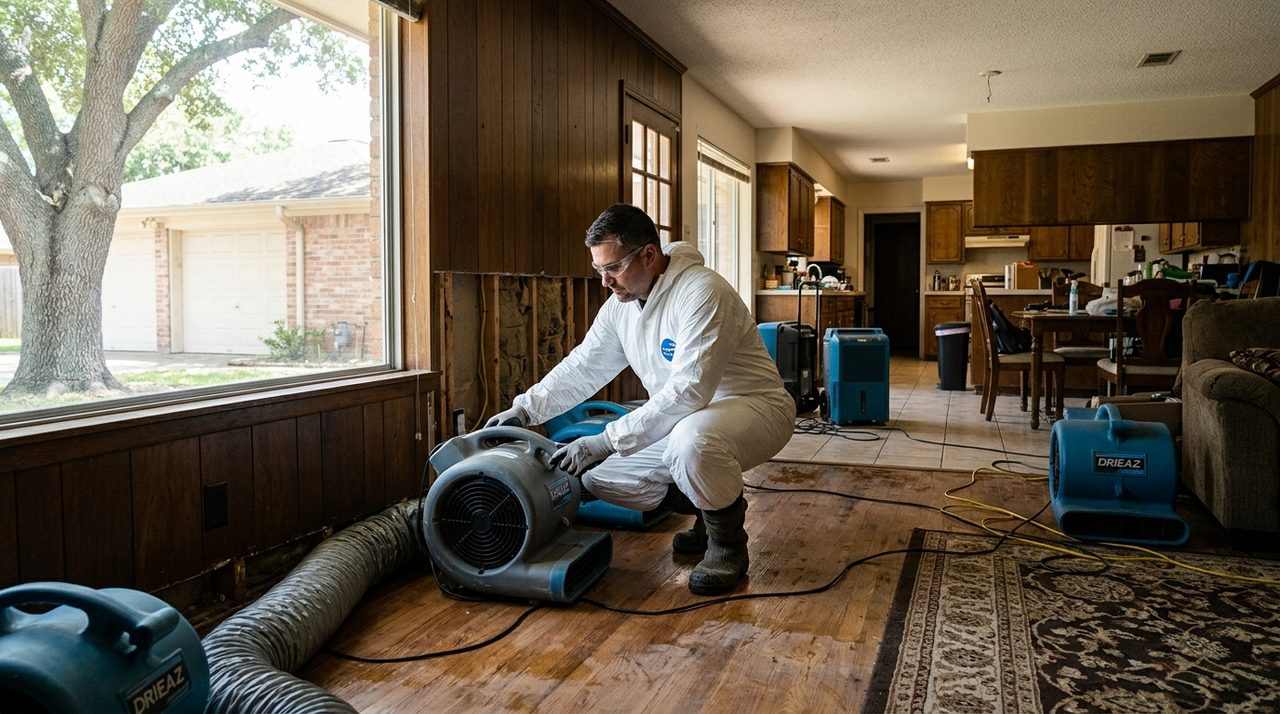
A qualified restoration contractor should take moisture readings at the slab edge, bottom plates, and lower drywall courses using calibrated meters — not just visually inspect the floor — before signing off on drying. IICRC S500 standards require drying to confirmed normal moisture baselines, not simply 'dry to the touch.' Because structural demo and drying work in Brookhollow falls under City of Houston permitting jurisdiction, the contractor should pull a demolition permit through the City of Houston Permitting Center before opening walls, which also creates a documented record for your insurance claim.
Sources: IICRC (water/mold restoration standards), City of Houston Permitting Center
Why it matters to you
Homes built in Brookhollow between the 1960s and 1980s commonly retain their original flex duct systems, and many have never had ductwork replaced or inspected. When floodwater or a major pipe burst introduces moisture into the structure, flex duct insulation absorbs and retains that moisture; Houston's average relative humidity above 70% and summer temperatures exceeding 90°F mean Aspergillus and Cladosporium colonies can establish within 48–72 hours of a moisture event. A homeowner who had the floors dried and drywall replaced after a 2021 Uri-era pipe burst, but never addressed the ductwork, may be circulating mold spores through the entire house today.
What a good pro does
Any water-restoration scope in a Brookhollow home of this era should include thermal imaging of the attic air handler and duct runs, and moisture sampling of accessible flex duct insulation. If ductwork replacement is warranted, a TDLR-licensed HVAC contractor must be involved, and the mechanical permit is pulled separately from the restoration demo permit through the City of Houston Permitting Center. Firms performing mold assessment or mold remediation in Texas must hold a TDLR-issued Mold Assessment Consultant (MAC) or Mold Remediation Contractor (MRC) license under Texas Occupations Code Chapter 1958.
Sources: IICRC (water/mold restoration standards), Texas Department of Licensing & Regulation, City of Houston Permitting Center
Why it matters to you
Winter Storm Uri in February 2021 hit the uninsulated attic supply lines and exterior-wall plumbing of Brookhollow's mid-century ranch homes particularly hard: original galvanized and early copper lines in unconditioned attic spaces froze and split across the neighborhood. Many homeowners patched the pipe and repainted the ceiling, but the wall cavity behind the drywall never reached normal moisture levels. Three-plus years later, restoration contractors called for an unrelated job — a slab leak, a new water heater, a bathroom remodel — routinely find residual microbial growth behind undisturbed drywall from that 2021 event.
What a good pro does
Before any reconstruction work begins in a Brookhollow home that did not receive a full professional drying scope after Uri, request a moisture scan of attic-adjacent walls and any ceiling that showed staining in 2021. If mold is confirmed, remediation must be performed by a TDLR-licensed Mold Remediation Contractor (MRC) before new drywall or insulation is installed. Plumbing repairs that open walls also require a TSBPE-licensed plumber to pull the appropriate trade permit through the City of Houston Permitting Center.
Sources: Texas Department of Licensing & Regulation, Texas State Board of Plumbing Examiners, City of Houston Permitting Center
Why it matters to you
The May 2024 derecho delivered sustained straight-line winds across northwest Houston, and Brookhollow's traditional brick-veneer ranch homes — with their original single-pane window installations and older soffit vents — were directly in the wind vector. Unlike floor flooding, wind-driven rain enters through brick weep holes, window flanges, and soffit penetrations and travels downward through wall sheathing and insulation to pool at the bottom plate, often with no visible interior water intrusion. Homeowners who filed only a roof claim and never investigated the wall assemblies may have saturated insulation and rotting bottom plates hidden behind perfectly intact interior drywall.
What a good pro does
A thorough post-derecho restoration inspection for a Brookhollow brick-veneer ranch should include infrared thermal imaging of all exterior-facing walls and any wall below a damaged soffit line, not just the rooms with obvious ceiling staining. Because this damage pattern originates outside the envelope rather than through the slab, the drying strategy differs from a floor-flood response: dehumidification and directed airflow must address the mid-wall cavity from both sides. Any structural demo required to access saturated sheathing or bottom plates requires a City of Houston demolition permit, and the restoration contractor typically pulls it before work begins.
Sources: IICRC (water/mold restoration standards), City of Houston Permitting Center, Harris County Flood Control District
Hiring water & flood restoration in Brookhollow? Brookhollow is a northwest Houston neighborhood along the US-290 corridor with housing stock generally dating to the 1960s–1980s. Homeowners here should expect maintenance patterns typical of aging slab-on-grade ranch homes, including HVAC system replacements, cast-iron drain line issues, and periodic foundation monitoring. The neighborhood falls within City of Houston permitting jurisdiction with no historic district restrictions limiting exterior modifications.
Building era
1960s–1980s (area-wide pattern; not confirmed for this specific subdivision).
Typical style
One- and two-story ranch, traditional brick, and contemporary traditional homes — based on area-wide NW Houston/US-290 corridor patterns.
Foundations
Concrete slab-on-grade (predominant for post-1960 NW Houston subdivisions; not independently confirmed for this specific neighborhood).
Common systems
Original homes likely have central A/C units nearing or past useful life, galvanized or cast-iron plumbing transitioning to PVC/PEX in renovated units, and older electrical panels (100–150 amp) that may need upgrading for modern loads.
What that means for repairs
Kitchen and bathroom remodels are common in homes of this era, along with re-piping from original galvanized or cast-iron lines, HVAC replacements, and foundation repair due to Houston's expansive clay soils.
Permit jurisdiction
City of Houston Permitting Center (neighborhood is within Houston city limits).
HOA & deed restrictions
Not confirmed — multiple 'Brookhollow' associations exist in Harris County (including Brookhollow Crossing Association, Inc. and Brookhollow Court HOA), but none could be reliably matched to the NW Houston Brookhollow area near US-290. Check Harris County Clerk records for recorded deed restrictions or management certificates tied to specific plat names.
Historic districts
No City of Houston historic district designation confirmed. Brookhollow does not appear on the HAHC list of designated historic districts, and no Certificate of Appropriateness is required for exterior work.
Contractor note
Contractors should verify lot-specific deed restrictions through Harris County Clerk records before planning exterior modifications, as HOA/POA governance for this specific Brookhollow area could not be confirmed. Standard City of Houston building permits apply.
FEMA flood zone
FEMA Zone X (low flood risk) — source: fema_nfhl. Specific bayou or creek proximity for this neighborhood could not be confirmed from available research; homeowners should verify drainage patterns at the parcel level using Harris County Flood Control District tools.
Hurricane Harvey impact
Harvey impact for the specific Brookhollow neighborhood near US-290 could not be confirmed from available sources. Harvey flood mapping in Harris County is organized by watershed rather than neighborhood name, and no news articles or HCFCD documents explicitly identified Brookhollow (NW Houston) for neighborhood-level Harvey inundation. The FEMA Zone X designation suggests lower overall flood risk, but parcel-level verification is recommended.
Heat & humidity load
Houston's extreme summer heat and humidity place heavy demand on aging HVAC systems common in 1960s–1980s homes. Slab-on-grade foundations in expansive clay soils may experience seasonal movement during drought-to-rain cycles, making foundation monitoring important. Attic insulation upgrades and proper roof ventilation are common service needs to manage cooling costs.
Working with contractors here
Contractors working in Brookhollow most commonly handle HVAC replacements, re-piping from original galvanized or cast-iron drain lines, and foundation repair — all driven by the aging mid-century housing stock typical of the US-290 corridor. Roof replacements on homes 30–50+ years old are frequent, and electrical panel upgrades are common as homeowners add modern loads. Because the HOA landscape is unclear, contractors should verify any exterior modification restrictions with the homeowner and Harris County deed records before scoping jobs. The City of Houston permitting process applies to all structural, electrical, plumbing, and mechanical work requiring permits.
Local Tip
Always ask for a written estimate before work begins. Texas contractors are required to provide one on jobs over $1,000.
Brookhollow is a northwest Houston neighborhood along the US-290 corridor with housing stock generally dating to the 1960s–1980s. Homeowners here should expect maintenance patterns typical of aging slab-on-grade ranch homes, including HVAC system replacements, cast-iron drain line issues, and periodic foundation monitoring. The neighborhood falls within City of Houston permitting jurisdiction with no historic district restrictions limiting exterior modifications.
Source: U.S. Census Bureau, ACS 5-Year 2023
Most of Brookhollow maps to FEMA Zone X (low mapped flood risk), but Houston's flash-flood reality means even low-risk blocks benefit from smart drainage and storm-hardened installs.
Source: FEMA National Flood Hazard Layer (NFHL). Flood zones vary by parcel — verify your individual FIRM panel.
Before hurricane season, commission a moisture baseline scan from an IICRC-certified restoration firm so any post-storm water intrusion in Brookhollow can be quantified and documented for your insurer immediately. Beryl 2024 showed that even low-mapped-risk neighborhoods saw flash flooding that saturated flooring assemblies within hours of peak rainfall. Much of the housing stock predates modern wind codes (median build year 1975), so retrofits matter more here. Confirm the current FEMA panel for your Brookhollow parcel — the area maps to Zone X, but adjacent lots can differ.
Straight-line winds exceeding 80 mph, as recorded during the 2024 derecho, broke seals on sliding glass doors and drove water into flooring assemblies throughout Brookhollow neighborhoods with no prior flood history. Contact a licensed Texas restoration firm — TDLR regulates their mold-assessment and remediation work — to inspect and dry any affected areas before summer humidity accelerates microbial growth. In-city Brookhollow work falls under City of Houston floodplain and permitting rules.
A hard freeze in Brookhollow can split a single supply line and deposit 50 or more gallons of water into a ceiling assembly before a homeowner locates the shutoff, and that volume requires more than fans and open windows to dry safely. Texas law under TDLR requires mold assessors and remediators to hold specific licenses, so verify your restoration contractor's credentials before you need them under emergency conditions. With a median build year of 1975, the older building stock here is more exposed to hard-freeze damage than newer construction. Confirm the current FEMA panel for your Brookhollow parcel — the area maps to Zone X, but adjacent lots can differ.
Sources: FEMA National Flood Hazard Layer (NFHL), Ready.gov -- Hurricanes, CenterPoint Energy -- Storm Center, City of Houston -- Emergency Preparedness, Ready.gov -- Winter Weather, Harris County Flood Control District
Houston-specific estimators to plan your project before you call a pro. All results are planning estimates — a licensed local pro confirms the details on site.
Disconnect & drain every outdoor hose bib
Remove hoses, drain the spigots, and cover each with an insulated faucet sock. Un-drained hose bibs are the #1 burst point in a Houston freeze.
Insulate exposed pipes in the attic & garage
Wrap any pipe in an unconditioned space (attic runs, garage walls) with foam sleeves. Houston homes rarely insulate these because they only matter a few nights a year — which is exactly why they burst.
Open cabinet doors & keep a pencil-width drip
On hard-freeze nights, open kitchen/bath cabinets so warm air reaches the pipes and let faucets on exterior walls drip to relieve pressure.
Protect the attic/garage water heater & its lines
An attic or garage tank sits in unconditioned space. Insulate the cold-inlet and hot-outlet lines and confirm the emergency drain pan is clear so a leak doesn't reach the ceiling.
This is a planning estimate only — actual requirements depend on an on-site assessment by a licensed Houston pro. If a pipe has already burst, shut off your main water supply and call a licensed Houston plumber immediately — freeze bursts flood fast.
Sources: City of Houston Permitting Center
Sources: FEMA National Flood Hazard Layer (NFHL)Harris County Flood Control District
Sources: IICRC (water/mold restoration standards)Texas Department of Licensing & Regulation
Sources: IICRC (water/mold restoration standards)City of Houston Permitting Center
Sources: EPA Lead Renovation, Repair and Painting (RRP) Rule