Open Now
14090 Farm to Market 2920 g151, Tomball, TX 77357
Porter's unincorporated Montgomery County footprint spans housing built across five decades — from 1970s rural-tract slabs to 2020s production homes in Valley Ranch — all sitting on the same Beaumont and Houston Black clay soils that expand and contract with every wet-dry swing. Because Porter is not within any incorporated city, foundation repair permits run through Montgomery County Engineering rather than a municipal office, and dozens of individual HOAs add their own approval layer on top of county requirements. Understanding that patchwork before signing a contract can be the difference between a clean repair and an unpermitted liability that surfaces at resale.
Ranked by verified Google rating × review volume × verification tier. How we rank →
Some highly-rated pros serve Porter from nearby and may not keep a Porter street address. Those are listed under "Also serving Porter" with their real city and distance, so you always know where each business is based.
14090 Farm to Market 2920 g151, Tomball, TX 77357
20885 Deuster Ln 3002 trinity pass Ct spring TX 77373, Porter, TX 77365
19701 Kingwood Dr #119, Porter, TX 77365
Highly-rated pros based nearby who cover Porter. Distance shown from the Porter area.
Serving Porter Based in Kingwood · 2.4 mi away
Serving Porter Based in Kingwood · 3.6 mi away
Serving Porter Based in Kingwood · 7.3 mi away
Serving Porter Based in Humble · 8.1 mi away
Serving Porter Based in Kingwood · 8.4 mi away
Serving Porter Based in Kingwood · 8.5 mi away
Serving Porter Based in Kingwood · 9.4 mi away
Why it matters to you
Porter's median home was built around 2001, placing a large share of the housing stock in the 1990s–2000s production-build era — homes whose slabs were poured directly on Houston Black clay without the post-tension designs more common in newer construction. During the 2022–2023 La Niña drought cycle, Montgomery County soils baked and pulled away from slab edges across subdivisions from North Country to older plats along FM 1314, leaving perimeter beams unsupported and triggering door-frame gaps and stair-step brick cracks that reopen every dry season.
What a good pro does
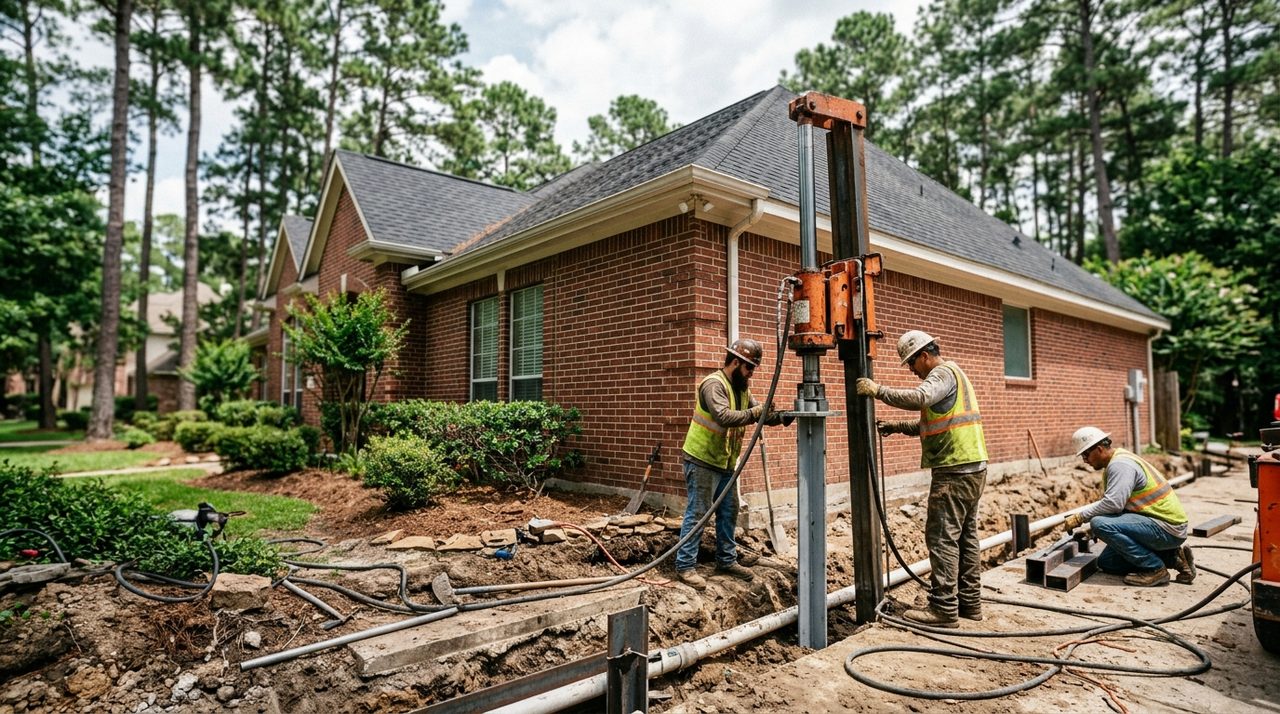
A qualified contractor will probe for perimeter voids, check interior floor levelness with a digital level, and recommend a targeted soaker-hose program around the foundation perimeter before committing to underpinning. For genuine settlement — not just shrinkage — steel push piers or helical piers anchored to stable soil below the active clay zone are the current standard; pressed concrete pilings installed during the 1980s–1990s era are no longer favored because their shallow embedment in Porter's clay makes them prone to re-settlement. Estimates for steel push pier work run roughly $1,200–$1,800 per pier installed, with a typical Porter home requiring 8–16 piers.
Sources: International Residential Code (as adopted by City of Houston), Municipal permit office (see area profile)
Why it matters to you
Porter's older plats — many developed between the late 1970s and early 1990s — commonly used cast-iron under-slab drain lines that are now 30–50 years old. Winter Storm Uri (February 2021) burst pipes across Montgomery County; many homeowners patched visible interior damage but left cracked under-slab sections in place. A slow, undetected drain leak saturates clay directly beneath the slab, first causing localized heave and then consolidation settlement as soil structure degrades — producing interior floor humps or dips that mimic pure soil movement and are frequently misdiagnosed.
What a good pro does
Before any foundation repair contract is signed on a pre-1995 Porter home, insist on a hydrostatic plumbing test — a licensed plumber (credentialed through TSBPE) pressurizes the drain system to identify leaks under the slab. The test typically costs $250–$400 and can save thousands by ruling out plumbing as the cause of movement before piers are installed into still-saturated soil. Any under-slab pipe repair or re-route must be performed or overseen by a TSBPE-licensed plumber.
Sources: Texas State Board of Plumbing Examiners, International Residential Code (as adopted by City of Houston)
Why it matters to you
Unlike homes inside Sugar Land or Pearland city limits, Porter properties fall under Montgomery County Engineering for permitting — a process many contractors who primarily work inside Houston or Harris County are unfamiliar with. On top of that, mandatory HOAs in communities like Valley Ranch and North Country require Architectural Control Committee (ACC) approval before any exterior foundation work — including perimeter trenching — begins. A contractor who pulls a county permit but skips HOA approval, or vice versa, leaves the homeowner exposed to stop-work orders and potential fines enforceable under the deed restrictions.
What a good pro does
Before scheduling any underpinning or mudjacking work, verify your subdivision's HOA status through the TREC HOA management-certificate database or your deed records, then confirm permit requirements directly with Montgomery County Engineering. A contractor experienced in unincorporated Montgomery County will obtain the county structural permit and submit ACC documentation simultaneously, building the HOA review window — typically 15–30 days in Valley Ranch — into the project timeline. Never rely solely on a contractor's assurance that permits or HOA approvals are 'not required' for foundation work in Porter.
Sources: Municipal permit office (see area profile), Local HOA / deed restrictions (see area profile), Texas Department of Licensing & Regulation
Why it matters to you
Porter's older acreage plats and unrestricted rural tracts — some developed in the 1970s and 1980s — frequently feature mature live oaks, water oaks, and Chinese tallow trees within 20 feet of the foundation. On Porter's expansive clay, these root systems extract moisture aggressively during dry months, causing the soil on the tree side of the slab to shrink and drop while the opposite side holds elevation — producing the characteristic diagonal drywall crack running from window or door corners. Unlike deed-restricted HOA subdivisions with heritage-tree protections, many unrestricted Porter tracts give homeowners more flexibility on root management, but the structural damage still requires professional evaluation.
What a good pro does
A reputable foundation contractor will map tree locations relative to the slab, document differential elevation across the floor, and distinguish tree-driven seasonal movement from permanent settlement requiring underpinning. Where a large tree is the primary driver, targeted root barriers and a consistent perimeter irrigation program can stabilize future movement; if settlement has already exceeded roughly one inch of differential, helical piers anchored below the root-active zone — typically costing $1,500–$2,200 per pier — are the appropriate repair. Any work involving Montgomery County permits should be confirmed through the county's Engineering office, not assumed to be exempt.
Sources: International Residential Code (as adopted by City of Houston), Municipal permit office (see area profile)
Hiring foundation repair in Porter? Porter is a sprawling, unincorporated Montgomery County area composed of dozens of individual subdivisions—some master-planned with mandatory HOAs, others completely unrestricted rural tracts. Housing ranges from 1970s-era homes on acreage to brand-new production builds in communities like Valley Ranch. Homeowners must navigate county-level permitting and widely varying deed restrictions, making it essential to verify rules at the subdivision level before any project.
Building era
1970s–2020s, with significant growth from the 1990s through 2010s and ongoing new construction.
Typical style
Mix of traditional single-family brick and frame homes in older plats, and newer production-style traditional homes in master-planned communities.
Foundations
Predominantly concrete slab-on-grade for post-1960 construction; some pier-and-beam in older or custom rural builds — specific subdivision data not confirmed.
Common systems
Newer homes typically feature central HVAC with high-SEER units, PEX or copper plumbing, and 200-amp electrical panels; older 1970s–1990s homes may have original R-22 HVAC systems, galvanized or CPVC plumbing, and 100–150-amp panels.
What that means for repairs
Older subdivisions see HVAC replacements, re-plumbing from galvanized to PEX, and kitchen/bath remodels. Unrestricted acreage tracts attract new construction, additions, and outbuilding projects. Master-planned communities focus on cosmetic updates and energy efficiency upgrades.
Permit jurisdiction
Montgomery County Engineering and applicable special utility districts (MUDs). Not within City of Houston or any incorporated city permit jurisdiction.
HOA & deed restrictions
Varies widely by subdivision. Valley Ranch HOA is mandatory for all property owners. North Country Homeowners Association, Inc. operates as a subdivision HOA. The Highlands is governed by a mandatory HOA. Many properties in broader Porter have no HOA at all. Confirm for any specific property via deed records or TREC HOA management-certificate database.
Historic districts
No historic district designation confirmed. Porter is in unincorporated Montgomery County with no City of Houston HAHC jurisdiction.
Contractor note
Contractors must obtain permits through Montgomery County rather than a city permit office. Additionally, many subdivisions require separate HOA architectural review committee (ACC) approval before exterior work begins, so contractors should verify both county and private-covenant requirements for each job.
FEMA flood zone
FEMA Zone X (low flood risk) per official NFHL data. However, properties near the East Fork of the San Jacinto River and its tributaries may carry higher risk; confirm flood zone at the parcel level as conditions vary across this large unincorporated area.
Hurricane Harvey impact
Parts of Montgomery County, including areas along the San Jacinto River and its tributaries, experienced flooding during Hurricane Harvey. Subdivision-specific or street-level Harvey impact data for the broader Porter area was not confirmed in available sources. Property-specific flood history should be verified through FEMA NFIP records and the Montgomery County floodplain administrator.
Heat & humidity load
Extreme summer heat and humidity drive heavy HVAC demand; older 1970s–1990s systems may struggle with efficiency. Slab foundations on expansive clay soils can shift during prolonged dry spells, and homes on rural lots with septic systems face additional stress during saturated-soil conditions in late summer storms.
Working with contractors here
Porter's wide range of housing ages means contractors encounter everything from 1970s-era galvanized re-pipes and aging R-22 HVAC changeouts to warranty work in brand-new master-planned communities. Unrestricted acreage properties frequently generate new-build, barndominium, and accessory-structure projects that require Montgomery County permitting and septic coordination. In HOA-governed subdivisions like Valley Ranch and North Country, exterior projects require ACC approval in addition to county permits, and contractors should budget time for that review process. The area's rapid growth means utility infrastructure varies—some neighborhoods are served by MUDs with specific tap and connection standards that affect plumbing and site work. Job scoping should always include verifying the specific subdivision's HOA status, applicable deed restrictions, and whether the property is on municipal water/sewer or septic.
Local Tip
Always ask for a written estimate before work begins. Texas contractors are required to provide one on jobs over $1,000.
Porter is a sprawling, unincorporated Montgomery County area composed of dozens of individual subdivisions—some master-planned with mandatory HOAs, others completely unrestricted rural tracts. Housing ranges from 1970s-era homes on acreage to brand-new production builds in communities like Valley Ranch. Homeowners must navigate county-level permitting and widely varying deed restrictions, making it essential to verify rules at the subdivision level before any project.
Source: U.S. Census Bureau, ACS 5-Year 2023
Most of Porter maps to FEMA Zone X (low mapped flood risk), but Houston's flash-flood reality means even low-risk blocks benefit from smart drainage and storm-hardened installs.
Source: FEMA National Flood Hazard Layer (NFHL). Flood zones vary by parcel — verify your individual FIRM panel.
Wind-driven rain during a hurricane can saturate soil on the windward side of your home while the leeward side stays dry, creating differential moisture conditions beneath your slab that show up as sticking doors weeks later in Porter, TX. Schedule a Zip-Level elevation reading after any named storm passes so a foundation professional can distinguish normal seasonal movement from storm-induced settlement requiring pier work. As a Montgomery County community, Porter may follow county rather than City of Houston storm rebuild rules.
The May 2024 derecho caused structural racking in thousands of Houston homes, and racking places diagonal tension on slab corners that can widen existing hairline cracks into visible gaps in Porter, TX over the following weeks. Schedule a foundation survey within 30 days of any severe wind event to establish a post-storm baseline before summer drying compounds any movement. Confirm the current FEMA panel for your Porter parcel — the area maps to Zone X, but adjacent lots can differ.
Winter Storm Uri's multi-day freeze caused Houston clay soils to go through freeze-thaw cycling not common in the region, and even low-flood-risk neighborhoods in Porter, TX saw new door-sticking and brick-step cracking appear in the spring following the storm. A post-winter Zip-Level survey establishes whether that movement is seasonal and self-correcting or progressive and in need of pier work before summer drying amplifies the differential. As a Montgomery County community, Porter may follow county rather than City of Houston storm rebuild rules.
Sources: FEMA National Flood Hazard Layer (NFHL), Ready.gov -- Hurricanes, CenterPoint Energy -- Storm Center, City of Houston -- Emergency Preparedness, Ready.gov -- Winter Weather, Harris County Flood Control District
Houston-specific estimators to plan your project before you call a pro. All results are planning estimates — a licensed local pro confirms the details on site.
Grouped by mature root aggression & water demand.
Trunk center to the nearest exterior wall.
The root zone likely reaches your foundation's soil during Houston's dry summers, when clay shrinks most. Watch for sticking doors and diagonal cracks, keep soil moisture even with a soaker hose during drought, and have a foundation pro evaluate if you see any movement.
Find a Houston foundation pro →This is a planning estimate only — actual requirements depend on an on-site assessment by a licensed Houston pro. Guidance is based on general species root behavior in expansive clay, not a soil test.
Disconnect & drain every outdoor hose bib
Remove hoses, drain the spigots, and cover each with an insulated faucet sock. Un-drained hose bibs are the #1 burst point in a Houston freeze.
Insulate exposed pipes in the attic & garage
Wrap any pipe in an unconditioned space (attic runs, garage walls) with foam sleeves. Houston homes rarely insulate these because they only matter a few nights a year — which is exactly why they burst.
Open cabinet doors & keep a pencil-width drip
On hard-freeze nights, open kitchen/bath cabinets so warm air reaches the pipes and let faucets on exterior walls drip to relieve pressure.
Protect the attic/garage water heater & its lines
An attic or garage tank sits in unconditioned space. Insulate the cold-inlet and hot-outlet lines and confirm the emergency drain pan is clear so a leak doesn't reach the ceiling.
This is a planning estimate only — actual requirements depend on an on-site assessment by a licensed Houston pro. If a pipe has already burst, shut off your main water supply and call a licensed Houston plumber immediately — freeze bursts flood fast.
Sources: Municipal permit office (see area profile)
Sources: Local HOA / deed restrictions (see area profile)
Sources: FEMA National Flood Hazard Layer (NFHL)Harris County Flood Control District
Sources: Municipal permit office (see area profile)Texas State Board of Plumbing Examiners