Closed
5902 W 34th St, Houston, TX 77092
Brookhollow's 1960s–1980s concrete slab-on-grade ranch homes sit directly on Harris County's Beaumont and Houston Black clay formations — some of the most expansive soils in North America — making foundation movement a near-certainty over a 40–60 year lifespan, not a remote possibility. Add the legacy cast-iron under-slab drain lines common in homes built along the US-290 corridor before 1990, and the risk of compounding slab damage from slow plumbing leaks is real. This page walks Brookhollow homeowners through the specific soil, age, and permitting realities that shape every foundation repair decision here.
Ranked by verified Google rating × review volume × verification tier. How we rank →
Some highly-rated pros serve Brookhollow from nearby and may not keep a Brookhollow street address. Those are listed under "Also serving Brookhollow" with their real city and distance, so you always know where each business is based.
5902 W 34th St, Houston, TX 77092
4321 Dayco St, Houston, TX 77092
6213 Peg St, Houston, TX 77092
2855 Mangum Rd #460, Houston, TX 77092
5235 Saxon Dr, Houston, TX 77092
Highly-rated pros based nearby who cover Brookhollow. Distance shown from the Brookhollow area.
Serving Brookhollow Based in Lazybrook / Timbergrove · 1.9 mi away
Serving Brookhollow Based in Lazybrook / Timbergrove · 2.1 mi away
Serving Brookhollow Based in Spring Branch · 2.7 mi away
Serving Brookhollow Based in Lazybrook / Timbergrove · 2.7 mi away
Serving Brookhollow Based in Lazybrook / Timbergrove · 2.8 mi away
Why it matters to you
Brookhollow's housing stock — median year built around 1975 — has been riding Houston's expansive Beaumont clay through 40-plus wet/dry cycles. Each La Niña drought year, like 2022–2023, bakes the clay and pulls it away from the slab perimeter; each heavy rain season swells it back. Over decades, this cycling causes one corner of a ranch-style slab to lift or drop relative to the others, producing diagonal drywall cracks at window corners, sticky interior doors, and separating brick mortar joints that repeat every season rather than stabilizing.
What a good pro does
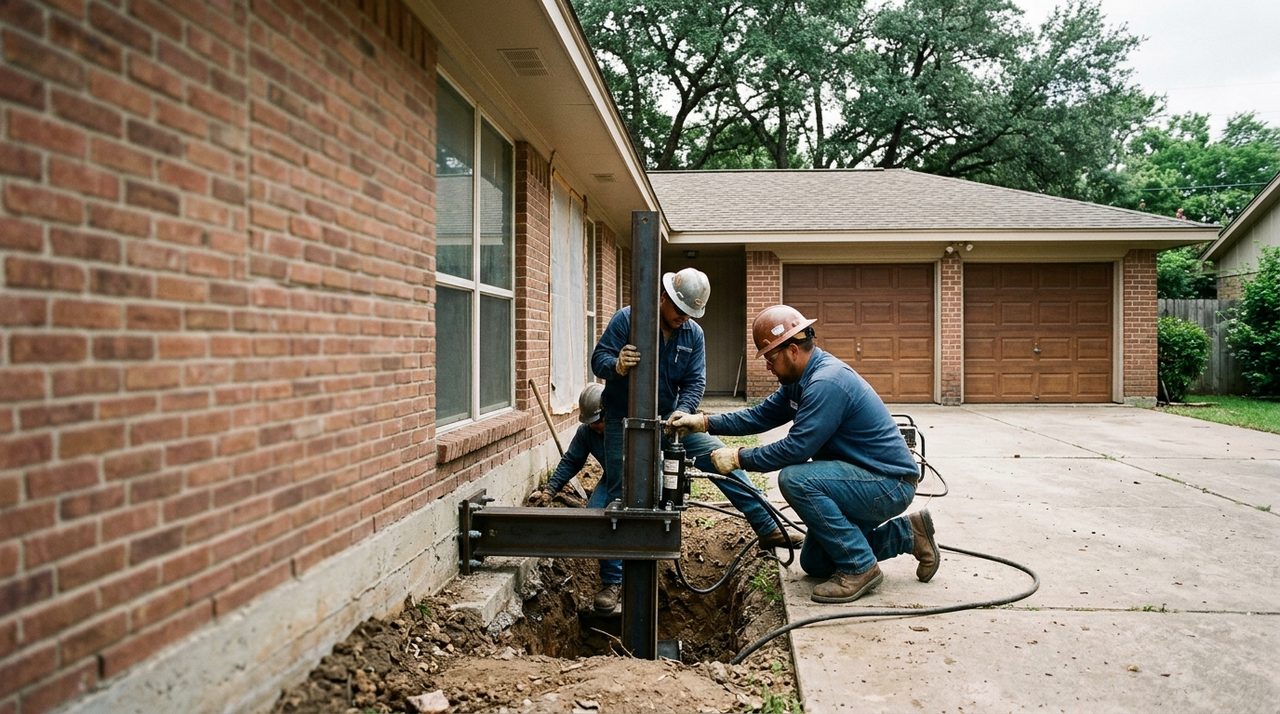
A competent foundation contractor serving Brookhollow will document differential movement with elevations at multiple slab points before recommending any pier type. For perimeter void formation, a soaker-hose irrigation regimen around the foundation perimeter during dry months is the first line of defense; actual underpinning with steel push piers or helical piers is warranted only when movement exceeds roughly one inch of differential. Any underpinning work requires a City of Houston foundation repair permit through the Houston Permitting Center — confirm the permit is pulled in your name, not just promised verbally.
Sources: City of Houston Permitting Center, Municipal permit office (see area profile)
Why it matters to you
Homes built in Brookhollow's primary development era — 1960s through the mid-1980s — almost universally used cast-iron under-slab drain lines. Winter Storm Uri in February 2021 froze and cracked thousands of these lines across NW Houston; many were patched at the wall but never tested below the slab. A slow, ongoing drain leak under a Brookhollow slab continuously saturates the surrounding clay, causing localized heave and then collapse of soil structure as organic material washes out — damage that a surface inspection alone will not catch and that a foundation contractor may misattribute to pure soil movement.
What a good pro does
Before signing any foundation repair contract, budget $250–$400 for a standalone hydrostatic plumbing test performed by a plumber licensed through the Texas State Board of Plumbing Examiners. If the test fails, the under-slab line repair must be scoped and permitted separately through the City of Houston under plumbing permit rules. Addressing the leak source first prevents a freshly repaired foundation from re-settling within a few years due to continued soil saturation.
Sources: Texas State Board of Plumbing Examiners, City of Houston Permitting Center, Municipal permit office (see area profile)
Why it matters to you
Many Brookhollow lots planted live oaks, water oaks, and Chinese tallow trees in the 1970s and 1980s that are now mature, with root systems extending 20–40 feet from the trunk. In the dry season, these roots aggressively extract clay moisture on the tree side of the slab, causing localized foundation drop that looks like general settlement but is actually asymmetric desiccation. The pattern — lower elevation on the north or west side of a slab nearest the tree line — is characteristic of this specific problem and distinct from perimeter void formation caused by drought alone.
What a good pro does
A thorough foundation contractor will map both slab elevations and the location of large trees relative to the low corners before recommending piers. When tree-root moisture depletion is the driver, root barriers and targeted irrigation on the affected side can slow future movement after repair. Because Brookhollow carries no City of Houston historic district designation and no confirmed mandatory HOA, homeowners here generally have full discretion to remove or trim trees as part of a foundation management plan — no Certificate of Appropriateness or HOA architectural review is required, though deed restriction records at the Harris County Clerk's office should still be checked for any lot-specific tree covenants.
Sources: Local HOA / deed restrictions (see area profile), Municipal permit office (see area profile)
Why it matters to you
Brookhollow falls entirely within City of Houston permitting jurisdiction, meaning any steel push pier, helical pier, or pressed piling installation requires a permit from the Houston Permitting Center — not a suburban city office, not unincorporated Harris County. Texas law requires sellers to disclose known foundation movement and repairs on the TREC disclosure form, and unpermitted foundation work discovered during a buyer's inspection can delay or kill a sale for a home already priced near the neighborhood's Census-estimated median of roughly $223,000. Given the neighborhood's 42% owner-occupancy rate, many Brookhollow properties cycle through sales, making documentation especially important.
What a good pro does
Require your contractor to pull a City of Houston foundation repair permit before any work begins and to schedule the required city inspection after pier installation is complete. Ask for a copy of the final inspection sign-off for your records — this documentation travels with the property and satisfies the TREC disclosure requirement cleanly. Contractors unfamiliar with COH's Development Services Department permit workflow should not be performing underpinning work in Brookhollow.
Sources: City of Houston Permitting Center, Municipal permit office (see area profile), Texas Department of Licensing & Regulation
Hiring foundation repair in Brookhollow? Brookhollow is a northwest Houston neighborhood along the US-290 corridor with housing stock generally dating to the 1960s–1980s. Homeowners here should expect maintenance patterns typical of aging slab-on-grade ranch homes, including HVAC system replacements, cast-iron drain line issues, and periodic foundation monitoring. The neighborhood falls within City of Houston permitting jurisdiction with no historic district restrictions limiting exterior modifications.
Building era
1960s–1980s (area-wide pattern; not confirmed for this specific subdivision).
Typical style
One- and two-story ranch, traditional brick, and contemporary traditional homes — based on area-wide NW Houston/US-290 corridor patterns.
Foundations
Concrete slab-on-grade (predominant for post-1960 NW Houston subdivisions; not independently confirmed for this specific neighborhood).
Common systems
Original homes likely have central A/C units nearing or past useful life, galvanized or cast-iron plumbing transitioning to PVC/PEX in renovated units, and older electrical panels (100–150 amp) that may need upgrading for modern loads.
What that means for repairs
Kitchen and bathroom remodels are common in homes of this era, along with re-piping from original galvanized or cast-iron lines, HVAC replacements, and foundation repair due to Houston's expansive clay soils.
Permit jurisdiction
City of Houston Permitting Center (neighborhood is within Houston city limits).
HOA & deed restrictions
Not confirmed — multiple 'Brookhollow' associations exist in Harris County (including Brookhollow Crossing Association, Inc. and Brookhollow Court HOA), but none could be reliably matched to the NW Houston Brookhollow area near US-290. Check Harris County Clerk records for recorded deed restrictions or management certificates tied to specific plat names.
Historic districts
No City of Houston historic district designation confirmed. Brookhollow does not appear on the HAHC list of designated historic districts, and no Certificate of Appropriateness is required for exterior work.
Contractor note
Contractors should verify lot-specific deed restrictions through Harris County Clerk records before planning exterior modifications, as HOA/POA governance for this specific Brookhollow area could not be confirmed. Standard City of Houston building permits apply.
FEMA flood zone
FEMA Zone X (low flood risk) — source: fema_nfhl. Specific bayou or creek proximity for this neighborhood could not be confirmed from available research; homeowners should verify drainage patterns at the parcel level using Harris County Flood Control District tools.
Hurricane Harvey impact
Harvey impact for the specific Brookhollow neighborhood near US-290 could not be confirmed from available sources. Harvey flood mapping in Harris County is organized by watershed rather than neighborhood name, and no news articles or HCFCD documents explicitly identified Brookhollow (NW Houston) for neighborhood-level Harvey inundation. The FEMA Zone X designation suggests lower overall flood risk, but parcel-level verification is recommended.
Heat & humidity load
Houston's extreme summer heat and humidity place heavy demand on aging HVAC systems common in 1960s–1980s homes. Slab-on-grade foundations in expansive clay soils may experience seasonal movement during drought-to-rain cycles, making foundation monitoring important. Attic insulation upgrades and proper roof ventilation are common service needs to manage cooling costs.
Working with contractors here
Contractors working in Brookhollow most commonly handle HVAC replacements, re-piping from original galvanized or cast-iron drain lines, and foundation repair — all driven by the aging mid-century housing stock typical of the US-290 corridor. Roof replacements on homes 30–50+ years old are frequent, and electrical panel upgrades are common as homeowners add modern loads. Because the HOA landscape is unclear, contractors should verify any exterior modification restrictions with the homeowner and Harris County deed records before scoping jobs. The City of Houston permitting process applies to all structural, electrical, plumbing, and mechanical work requiring permits.
Local Tip
Always ask for a written estimate before work begins. Texas contractors are required to provide one on jobs over $1,000.
Brookhollow is a northwest Houston neighborhood along the US-290 corridor with housing stock generally dating to the 1960s–1980s. Homeowners here should expect maintenance patterns typical of aging slab-on-grade ranch homes, including HVAC system replacements, cast-iron drain line issues, and periodic foundation monitoring. The neighborhood falls within City of Houston permitting jurisdiction with no historic district restrictions limiting exterior modifications.
Source: U.S. Census Bureau, ACS 5-Year 2023
Most of Brookhollow maps to FEMA Zone X (low mapped flood risk), but Houston's flash-flood reality means even low-risk blocks benefit from smart drainage and storm-hardened installs.
Source: FEMA National Flood Hazard Layer (NFHL). Flood zones vary by parcel — verify your individual FIRM panel.
Houston's flash-flood reality means even low-mapped-risk areas like Brookhollow can see sheet flow accumulate against a foundation during a slow-moving Gulf system, so verify that your perimeter drainage is clear and properly sloped before hurricane season opens. A TDLR-licensed foundation contractor can add or reposition surface drains to intercept runoff before it softens the clay bearing layer beneath your slab. Much of the housing stock predates modern wind codes (median build year 1975), so retrofits matter more here. Confirm the current FEMA panel for your Brookhollow parcel — the area maps to Zone X, but adjacent lots can differ.
Even with low mapped flood risk, Brookhollow is not immune to the localized sheet flow that accompanies a Houston severe thunderstorm, and repeated minor inundation at the foundation perimeter sustains the clay moisture that drives slow heave cycles. A pre-storm season inspection confirming that soil grade, splash blocks, and downspout extensions all direct water away from the slab is the most cost-effective foundation repair step you can take. In-city Brookhollow work falls under City of Houston floodplain and permitting rules.
Winter Storm Uri's multi-day freeze caused Houston clay soils to go through freeze-thaw cycling not common in the region, and even low-flood-risk neighborhoods in Brookhollow saw new door-sticking and brick-step cracking appear in the spring following the storm. A post-winter Zip-Level survey establishes whether that movement is seasonal and self-correcting or progressive and in need of pier work before summer drying amplifies the differential. With a median build year of 1975, the older building stock here is more exposed to hard-freeze damage than newer construction. Confirm the current FEMA panel for your Brookhollow parcel — the area maps to Zone X, but adjacent lots can differ.
Sources: FEMA National Flood Hazard Layer (NFHL), Ready.gov -- Hurricanes, CenterPoint Energy -- Storm Center, City of Houston -- Emergency Preparedness, Ready.gov -- Winter Weather, Harris County Flood Control District
Houston-specific estimators to plan your project before you call a pro. All results are planning estimates — a licensed local pro confirms the details on site.
Grouped by mature root aggression & water demand.
Trunk center to the nearest exterior wall.
The root zone likely reaches your foundation's soil during Houston's dry summers, when clay shrinks most. Watch for sticking doors and diagonal cracks, keep soil moisture even with a soaker hose during drought, and have a foundation pro evaluate if you see any movement.
Find a Houston foundation pro →This is a planning estimate only — actual requirements depend on an on-site assessment by a licensed Houston pro. Guidance is based on general species root behavior in expansive clay, not a soil test.
Disconnect & drain every outdoor hose bib
Remove hoses, drain the spigots, and cover each with an insulated faucet sock. Un-drained hose bibs are the #1 burst point in a Houston freeze.
Insulate exposed pipes in the attic & garage
Wrap any pipe in an unconditioned space (attic runs, garage walls) with foam sleeves. Houston homes rarely insulate these because they only matter a few nights a year — which is exactly why they burst.
Open cabinet doors & keep a pencil-width drip
On hard-freeze nights, open kitchen/bath cabinets so warm air reaches the pipes and let faucets on exterior walls drip to relieve pressure.
Protect the attic/garage water heater & its lines
An attic or garage tank sits in unconditioned space. Insulate the cold-inlet and hot-outlet lines and confirm the emergency drain pan is clear so a leak doesn't reach the ceiling.
This is a planning estimate only — actual requirements depend on an on-site assessment by a licensed Houston pro. If a pipe has already burst, shut off your main water supply and call a licensed Houston plumber immediately — freeze bursts flood fast.
Sources: City of Houston Permitting Center
Sources: Texas Department of Licensing & RegulationTexas State Board of Plumbing Examiners
Sources: Local HOA / deed restrictions (see area profile)City of Houston Permitting Center